
Feeding Bees Sugar Water: A Practical Guide
Most beekeepers will face a situation where they need to feed their bees sugar water. While sugar water is not a replacement for honey or natural forage, it can help sustain a colony that is low on food. I’ll share when feeding may be helpful, how to make sugar water for bees and how I use it in my apiary.
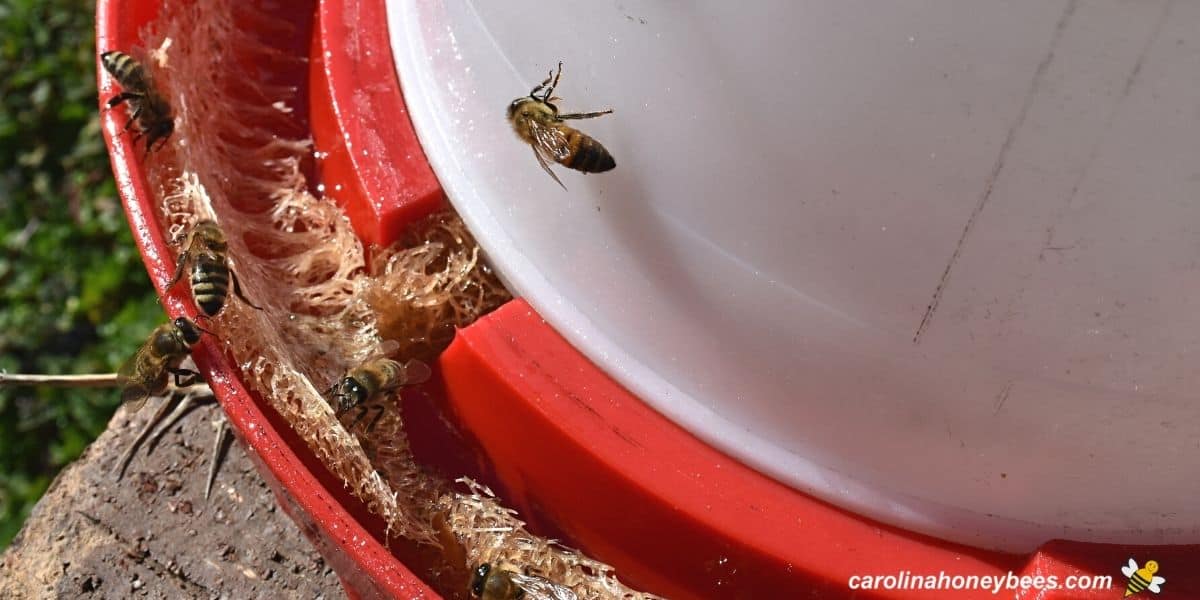
We beekeepers get some funny looks pushing carts full of sugar through the market. But, used at the right time and for the right reason, supplemental feeding can be an important part of good hive management.
When Do Bees Need Sugar Water?
Honey bees do not always need supplemental feeding. A healthy colony with plenty of stored honey and good natural forage is usually better off gathering its own food.
Newly installed packages, caught swarms and new splits are common situations where feeding may be helpful.
Established colonies may also need help during a drought, prolonged poor weather or when food stores become dangerously low.
Colonies short on stored honey going into fall may need supplemental feeding before winter.
Routine hive inspections are one of the best ways to decide whether an established colony needs help. Look at stored honey and consider what is blooming, recent weather and colony strength.
Hive weight can also provide a clue. I often lift the back of a hive to get a feel for its weight. If most colonies feel heavy and one feels noticeably light, it is worth a closer look.
Don’t feed according to a calendar. Consider the colony, its food stores and local forage conditions before deciding whether supplemental feeding is needed.
How to Make Sugar Water For Bees
Sugar water (or sugar syrup) is made by dissolving regular granulated white cane sugar in water.
Do not use brown sugar, raw sugar, molasses or artificial sweeteners. Plain white granulated sugar and water are all you need.
Choosing the Right Sugar Water Ratio
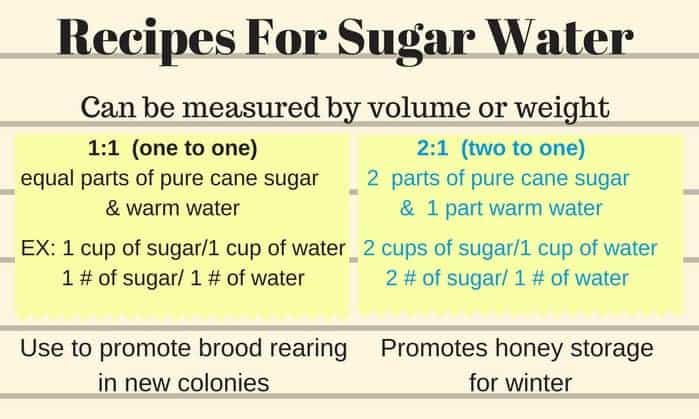
The two most common ratios are 1:1 and 2:1. You can measure by weight or volume—don’t overthink this part.
1:1 sugar water: Mix equal amounts of sugar and water, such as 2 cups of sugar and 2 cups of water.
2:1 sugar water: Use twice as much sugar as water, such as 8 cups of sugar and 4 cups of water.
Warm water helps dissolve the sugar, especially for thicker 2:1 syrup. There is no need to boil it. These ratios are guidelines for different feeding goals, not rigid rules.
One-Gallon Sugar Water Recipe
For about one gallon of finished 1:1 syrup, use:
- 10 2/3 cups granulated sugar
- 10 2/3 cups warm water
Don’t stress over exact measurements. Even natural nectar varies in sweetness.

When to Use 1:1 or 2:1 Sugar Water
The ratio you choose depends on why you are feeding and the needs of the colony.
Generally, 1:1 syrup is commonly used during spring and periods of colony growth, while 2:1 is often used when colonies need to increase food stores before winter.
These are guidelines—not rules. Climate, forage, colony strength and stored food should always be considered.
| Situation | Common Choice | Purpose |
|---|---|---|
| New colony or spring buildup | 1:1 | Supports colony development and comb building |
| Temporary warm-season shortage | 1:1 | Provides food until forage improves |
| Fall storage shortage | 2:1 | Provides a more concentrated feed |
| Cold-weather emergency | Solid feed may be preferable | Avoids adding excess liquid moisture |
During a nectar dearth, drought or prolonged poor weather, a colony with low stores may need temporary feeding.
In fall, colonies short on winter stores are often fed 2:1 syrup. See my fall bee feeding guide for more information.
Liquid feeding becomes more difficult as temperatures fall. If a colony needs emergency food during cold weather, solid feed may be a better choice.

Get the Buzz on Beekeeping & Life with Bees..
Subscribe to my weekly newsletter. Practical beekeeping guidance, along with honey uses, beeswax projects, and bee-friendly gardening ideas.
How to Feed a Colony Safely
There are several types of bee feeders, and each has advantages and disadvantages.
Whatever you choose, avoid spilling or leaking syrup around the hive as this can increase the risk of honey bee robbing.
When robbing is a concern, feeding inside the hive is often a better choice than open feeding.
Never feed sugar water while honey supers intended for human harvest are on the hive.
Bees may store the syrup in the comb along with nectar. Also, avoid overfeeding, which can crowd the brood nest with stored syrup.
Sugar water can spoil, especially in warm weather. If it becomes cloudy, sour, moldy or smells fermented, throw it out and clean the feeder before adding fresh syrup.

How Long Should You Continue Feeding?
There is no set amount of time to feed bees sugar water. A new colony may need help while getting established, while an established colony may only need temporary feeding during a nectar shortage.
As natural forage improves and the colony has adequate food stores, supplemental feeding may no longer be needed. For more details, see when to stop feeding bees sugar water.
Expert Tips
Ask five beekeepers about feeding bees and you may get six different answers—and someone at the local beekeeping association meeting will probably tell you that you are wrong!
A couple of tips from my years in the bee yard:
- Watch new colonies closely. New beekeepers sometimes stop feeding packages or splits too soon. Check their progress and food stores rather than feeding for a set number of weeks.
- Plain sugar water is fine. I sometimes add a feeding supplement or use homemade essential oil for bees recipes but additives are optional.
FAQs
Feeding bees does not make them lazy. In fact, honey bees prefer natural nectar. They may ignore your sugar water if food in the field is plentiful.
The bees will use any nectar (or nectar-like substance) to make honey. Honey produced from sugar water instead of nectar – that’s a no no. And, its not real honey.
Bees may ignore sugar water when plenty of natural nectar is available. Also, check that the syrup is fresh and the feeder is working properly.
Yes. Make small batches and store extra syrup in the refrigerator until needed. If it becomes cloudy, sour or smells fermented, throw it out.
Final Thoughts
Making and feeding sugar water for bees is a lot of work and expense (if you have more than one hive). You should not have to feed every colony all season. If this is happening, something is wrong. Pay attention to food stores, weather and natural forage—and let the condition of the hive tell you when help is needed.
You are promoting open feeding here with your pictures and at least one contributor says they feed bees in their porch. Please, please don’t. Open feeding is the perfect way to spread diseases amongst bees. Do not do it and do not encourage it!!!
I respect your opinion but I do practice some open feeding. Well away from the hives and only in certain situations. Bees are going to come into contact with other bees at watering holes, during mating flights and while foraging. No disease problems that I am aware of in my apiary. I’ve never said open feeding was the best option – it sure is not. But, I will continue to believe that it works well in some situations. Not on my porch though !!!
I’m having some timber cut and they have cut 4 trees with bees in them is it worth the effort help the bees make it through the winter. It’s early November in east Texas. There are some f bushes blaming now for pollen but very little nectar is available.put them in a box and try to
I’m not sure of your climate. In Texas you also have to be concerned about Africanized bees. I would work with a local beekeeper for assistance. If it was here, I would set up the logs on a stand and leave the bees in the trees over winter if possible. You could even contrive a way to put a small super on top of the top log for feeding.
Hi Charlotte,
This is Nevin in Ocean Shores, WA. We live in a pretty cool climate here on the coast. I worry if there is enough flowers here for them to survive. I have watched the bees return to the hive and I typically see many bees with lots of pollen attached to their hind legs. I purchased a NUC in mid May and have been feeding them sugar water since then. There is some stored honey on the 5 frames that came with the NUC..
When to know if the bees need feeding? Can you judge if you need to feed your bees by the amount of stored honey in your hive? What is the minimal amount of stored honey necessary. For example lets say that a hive has 10 square inches of stored honey is that enough honey to carry a hive over the winter assuming a normal number of bees in the hive?
I hope these are not dumb questions.
Not dumb questions at all. Bees in most regions need 1 entire box of honey for Winter. In colder areas, they need more. The available forage in the field will ebb and flow during the season. Pollen is a good sign but that does not mean they are finding nectar. I keep feed on my bees as long as they are taking it and never let it run dry until, a new colony has pulled out all the comb they will need and stored some “honey”. If you find that your bees are not taking the sugar water (great – they are finding natural nectar), take it away for a couple of weeks and then offer some again until they have established the hive.
Hello
I’m a new beekeeper from Algeria, my question is, can I save the sugar water liquid in the refrigerator for feed bees in this summer , thanks
Hi, Yes you can save it in the refrigerator for several days. Even better – you can freeze it for months!