
Homemade Yellow Jacket Trap

Yellow jacket wasps are beneficial insects but they can be a big problem. These aggressive wasps are attracted to food and may show up to ruin your outside picnic. While there are many commercial traps available, it is easy to make your own homemade yellow jacket trap. In this guide, you will learn how to build a simple effective diy yellow jacket trap with materials you may already have on hand.
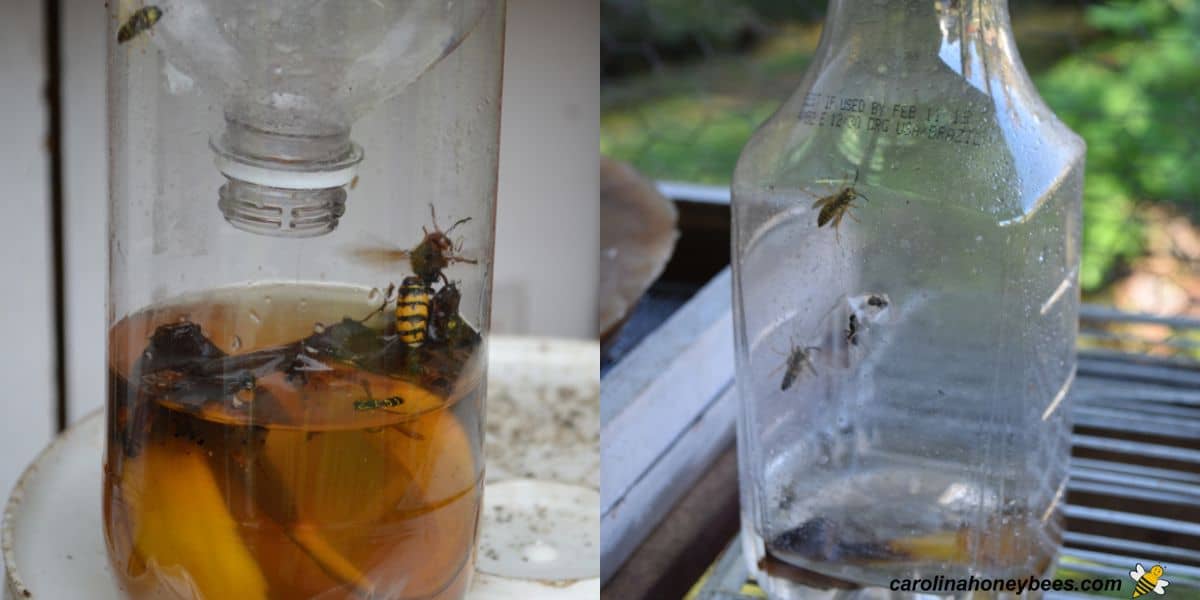
For us beekeepers, we know that a large population of wasps can cause serious problems in the bee yard. They are related, but yellow jackets and honey bees are very different and wasps do prey on honey bees.
Why Make a Homemade Yellow Jacket Trap?
Unfortunately, the time of year when Yellow Jackets pose the biggest threat is also the time when we are enjoying being outside.
During late Summer the nest size is at its peak. This means hundreds of hungry wasps patrolling around our homes and backyards – and bee yards!
Trapping wont completely solve the problem but it can help drastically reduce the number of flying wasps.
Supplies You Will Need

There are many ways to construct a homemade wasp trap for yellow jackets. This is a popular one that uses a plastic soda bottle.
But, you can modify the instructions to work with the materials you have.
- container – plastic bottle
- bait – recipe (apple cider vinegar, sugar, water, banana peel)
- water
Container
DIY Yellow Jacket Traps come in many different styles – this one is made from an empty 2-litre soda bottle. It is a great lesson in recycling and getting good use out of an empty bottle. You can use a slightly smaller container but you want room to catch a lot of wasps.
Milk jugs with a small entry hole work too. The goal is simply to lure yellow jackets into a container where they cannot easily find the exit.
Trap Bait
Bait preferences vary by location and season. I prefer the recipe below because it attracts yellow jackets without the odor of meat-based baits.
Important tip: do not use bait your yellow jacket trap with sweet concoctions that will attract beneficial bees and nonaggressive pollinators.
Water
A small amount of water in the base of the trap helps drown any captured insects. Some folks add soap to it but you don’t have to.
How much water you need – if any – depends a bit on the container you choose.
DIY Yellow Jacket Trap Tutorial
Main steps in making a diy yellow jacket wasp trap from a plastic bottle.

1. Cut off the top third of the bottle and invert it to create a funnel leading into the trap.
2. Mix up your wasp bait (recipe below) – and excess can be stored in a sealed bottle.
3. Pour liquid bait to a level of 3-4” in the base of the container add banana peels.
4. Insert the bottle top upside down into the bottom half to create a funnel leading into the bait. It won’t form a tight seal, and that’s perfectly fine.
5. Hang your trap in a shady location near a brighter area where yellow jackets are active. I often suspend mine under the barn eaves with wire or string.
This helps keep rain out of the bait and protects the trap from raccoons, opossums, and other curious visitors. You can also place it on a shelf or other sheltered spot.
Choosing the Best Bait
People often disagree about the best yellow jacket wasp trap bait. However, vinegar is a common ingredient.
My recipe uses vinegar, sugar water (just a bit) and banana to attract yellow jacket wasps, bald-face hornets and other types of wasps. (Recipe in card at bottom of article)
This mixture is not as attractive to honey bees – which is my main reason for using it.
I hear reports of success with traps that are baited with meat scraps (hamburger meat), hot dogs, cat food or even bits of fish. Hang those far away from you – they will smell.
Some users report seasonality preferences – sweet baits are used for early season activity and protein baits perform better for late summer and fall.
Also, a few folks swear that using a little beer in their bait is good.
Whichever, yellow jacket bait solution you use– keep a close eye on the trap for the first few days to ensure that you are capturing the target insects only.
You should see few if any honey bees in your trap.
Where to Place Your Trap for Best Results
Trap placement is just as important as bait selection.
Around Patios & Outdoor Living Areas
Place traps 20 to 30 feet away from patios, decks, and outdoor dining areas. Hanging a trap directly beside seating areas may attract more yellow jackets to the space. Position traps near flight paths or other areas where yellow jackets are already active.
Garden and Fruit Trees
Ripe split vegetables and fruits often attract yellow jackets by providing an easy source of sugar for foragers. Hang traps near the edge of the garden to reduce yellow jacket activity among the plants.
Around Beehives
During late summer and fall, yellow jacket populations peak and weak honey bee colonies can become targets.
Place traps several yards away from hives and monitor them regularly to avoid catching non-target insects. In severe years, several traps around the apiary perimeter often work better than a single trap.
More Placement Tips
- Choose a location protected from strong wind.
- Keep traps out of reach of children and pets.
- Refresh bait regularly for maximum attraction.
- Use multiple traps when yellow jacket populations are high.
- Move the trap if you see little activity after several days.
Tips for Better Results

This post may contain affiliate links. Carolina Honeybees earns a tiny commission when you shop from our links. See our privacy policy for terms.
Why Isn’t My Trap Working?
If your trap isn’t catching many yellow jackets, the problem is usually the bait or location.
Try moving the trap closer to areas where yellow jackets are active and refresh the bait regularly.
Food preferences can change throughout the season, so don’t be afraid to experiment with different bait options.
What If the Trap Catches Honey Bees?
A few accidental captures can happen with any trap. To reduce the risk, avoid using honey or overly sweet baits.
Vinegar-based mixtures tend to be less attractive to honey bees while still drawing yellow jackets.
Homemade vs. Store-Bought Traps
If you don’t have the time or desire to make your own yellow jacket trap, try one of the commercial ones.
They come in different styles. Please don’t use the cute ones that use rich sugar water as bait and kill honey bees.
If you don’t have the time or desire to make your own yellow jacket trap, you may decide to try one of the commercial ones.
They come in different styles. Please don’t use the cute ones that use rich sugar water as bait and kill honey bees.



What I’ve Learned
In my experience, bait choice and placement matter more than the trap design itself.
If one bait isn’t working, try another and move the trap to a more active location. For maximum success, experiment with bait type and trap placement.
FAQs
All traps work sometimes, none work exactly the same in every location. But – yes, a wasp trap can catch Yellow Jackets and other stinging insects. The number you capture depends a great deal on where you live and the number of nests nearby.
Yellow jacket activity seems to hit a peak between 10 am and 4 pm but they do forage in cooler temperatures than honey bees.
Refreshing trap bait weekly (or when the trap is full/congested) will increase your changes of trapping success..
Baiting practices vary greatly from one location to another. One popular recipes uses sugar water, banana and a small amount of vinegar. Another recipe uses beer, water and fruit punch.
No, a Yellow Jacket colony does not over-winter as a family-only the queen wasp hibernates during Winter. In Spring, she emerges and begins a new nest and family. This is also true for Carpenter Bees and Bumble Bees.
Final Thoughts
Reducing the number of various bee and wasp nests in your general area has some benefits. Yellow Jackets, hornets and other Wasps may be considered pests. But, they feast on many undesirable insects too -an excess of spiders, flies and worms that destroy food crops. Make good decisions and do not destroy insects unless absolutely necessary.
How to Make a Yellow Jacket Wasp Trap
This post may contain affiliate links. As an Amazon Associate, I earn from qualifying purchases.
Read my Disclosure.Tools
- scissors
Supplies
- 1 2 litre plastic soda bottle (any tall bottle)
- 1 banana peel
- 1 cup Apple Cider Vinegar
- 1/2 cup granulated sugar
- 1 cup water
Instructions
- You need a plastic bottle. An empty 2 liter soda bottle is ideal. If that is not available, any plastic bottle of the correct shape will do. (I like a clear bottle so I can see the little suckers in there.)

- Carefully cut the top 1/3 of the bottle off. You now have 2 parts. If you had the small plastic lid, you can throw that away – you don’t need it.
- Recipe for wasp bait: Gather your ingredients: 1 cup of vinegar, ½ cup of sugar, 1 cup of water and 1 banana peel. Now let me say that you may experiment with other combinations to see which one works better in your area. Some folks add a few drop of dish soap to break up the surface tension of the water and help drown the wasps.Do not use just sugar water (or honey!) – that will result in dead honey bees instead of wasps.
- Mix the liquid ingredients of your wasp trap bait in the bottom half of the bottle. Stir well to dissolve the sugar as best you can. Then add the banana peel.
- Invert the top cut part of the bottle and place it upside down into the larger section. This forms a funnel with the hole near the middle of the larger bottom piece. The shape of the neck of the bottle (now upside down) confuses the wasps and helps prevent escape.
- Set trap outside in a location that is protected from rain. You can use string, cord or part of a wire clothes hanger to create a handle if you wish. Attach it to a fence post or hang it from a tree limb.In a few days, the scent of the bait should attract hungry wasps and they will drown in the soapy solution. Sometimes the trap will catch Yellow Jackets or hornets in a short period of time. And, sometimes it may not seem to work at all.


If you locate the hive, you’ll see the yellow jackets tend to fly in one direction when they leave and fly back from the same direction. Placing the trap along that path will give you the best results. If you can raise it to the height of their flight path the results can be staggering!
That’s good advice John.
Do you know from how far away the traps will attract the wasps?
What is a good distance from the hive to set up a wasp trap?
Well, I’m not sure how far away they will attract a wasp from. I have seen beekeepers that had them very close but I chose to put my traps about 12-15 feet away. They just need to be in the general area.
Next I’m going to try the Italian sausage with a bit of sweet BBQ sauce. I think the more picnic-y I can make the trap, the more effective it will be. Just a theory.
Go for it .. LOL
I have two reusable yellow jacket traps outside my house. They both have the attractant that came with the trap, but the instructions say to also put some additional bait in it. It recommended meat or, in late summer, sweet carbs.
In one, I put a teaspoon of jam; in the other, I put a small piece of Italian sausage. There’s really no comparison between my two traps — sausage is a MUCH better yellow jacket bait than jam.
I didn’t think about bees when setting out my traps, but it seems to me that using meat for bait not only keeps bees safe by not attracting them, but really REALLY attracts the yellow jackets.
I agree that was a concern for me as well. It seems that the vinegar in most recipes makes it less attractive to bees. I have rarely caught a honey bee in mine. However, I am very cautious about putting anything too sweet in there. Sounds like you found a great recipe that works for you. Congratulations.
Hello Charlotte,
I am involved in a book project on the Mint Family of Plants: Lamiacea. I am wondering about all the bees I see in my garden around my Salvia ‘Indigo Spires” plants. I have thought they were yellow jackets, but after reading your website I am wondering if they are honey bees.
They seem to be drawn to many of my blue/purple blooming plants. I am hoping to write a chapter on the relationship of pollinators in the mint and herb garden and how we can encourage them. Any thoughts.
Randy Collins
Aiken, SC
How wonderful Randy. You are most likely seeing honey bees. My bees love the mint and salvia in my garden. They are especially fond of my Black Adder Hyssop. Yellow jackets and other wasps do like sweet things like nectar. But they are primarily meat eaters. Honey bees really enjoy many of the herbal plants. Thanks for letting bees enjoy your garden.
I used a old yellow jacket trap that had bin hanging in a tree for a year. cut a slit in it
and add dog food and in 30 min. it had about 25 of the little buggers in it.
That’s awesome Kenneth! Whatever works. And sometimes we have to experiment.
The beginning of the article says they are meat eaters, yet there is no meat in this recipe. I’ve tried the banana, vinegar, etc recipe and caught nothing. Should I use meat with these other ingredients or what? I at a loss!
They are meat eaters but they love sweet things to. Ever had a yellow jacket buzzing around your soda can at a picnic. I wouldnt add meat but maybe play around the the amounts of the ingredients.
I must have really smart yellow jackets, after 8 hours, only one fly, nothing else. I did exactly what you said to do.
Everything doesnt work for everyone everywhere. Mine work most years and some times of the summer the wasps dont seem to care about them. A friend that lives in the next state catches them by the hundreds.
I agree it is odd Karen. Some years I caught alot using the recipe and the next year it is not as successful.
Thanks will try the bananas. Will also try other baits as the ingredients are cheap and plentiful.
We recently have wasps under the vertical wooden siding where it meets some stone masonry siding. My husband sprayed, no success. So he caulked the edge with black foaming spray. Mistake. Even if you do use caulk, I read that you should use silicone caulk. But probably shouldn’t caulk while wasps are in your walls! We could hear the wasps chewing through the caulk. So per a youtube video, my husband set up our shop vac with the extra wands/tubes, whatever they’re called. In the evening when it was cool and no wasps flying, he bungee corded the wand to an a frame ladder so that the end was a couple inches from some of the holes. We used the crevice attachment so that it really sucked! He has also attached the vac wand to a push broom so that he could lean the broom up against the house. Use your imagination so that the vacuum tube end is by the hole. Then turn on in the daytime when you see wasps. We got hundreds when they were coming out of the siding and hundreds when they would fly from somewhere else heading to the holes. they go right in. Sometimes when we were moving the tube wasps would fly over to the end and go right in. (don’t where bright clothes) The youtube video showed putting water in the vac. We didn’t. I think the wasps get beaten up so badly by the suction and hitting the sides of the vac, they are killed. You can try with just one wasp and see for yourself what it does, so you don’t have to worry that they are still alive in the vac. This is a lot less messy than the water in the bottom. Anyway, still a few hangers on and wasps in the ground so going to make lots of little traps.
Thank you so much for raising and taking care of bees!
I’ve use teriyaki sauce that I’ve soaked chicken in for 2-3 days before BBQing. This small chicken fragments and fat combined with the sweetness of the teriyaki sauce draws them in. One trap caught 75-100 yellow jackets in a day.
WOW, cant blame them – that sounds pretty good!
I am trying to protect monarch butterfly caterpillars. Do I place the trap by the milkweed plants or up above or by the wasp nests?
I’m not sure, I would think in the proximity of either would work.
What can I use if I have no babana peels. Can jelly work instead of jam?
Yes, jelly would work but I think you must use the bananas.
Hello. Does the vinegar have to be apple cider vinegar, or will plain vinegar work?
Thanks.
I’ve never heard of anyone using white vinegar so I would go for the apple cider one. Doesnt have to be expensive though, you can find a cheap store brand.
would the trap attract more bees
I’ve never had that problem.
Hello, is there a specific height to place the traps? Thank you.
Some people say over 12 feet. But my traps are only about 7 feet off the ground. I think all heights can be successful.
I’m not a new-bee but thanks for the recipe !! This trap works well—I put baked apple juice in them and it worked well—1 or2 honeybees.. Always glad to learn something new—Thanks.
Tom Roth
I’m so glad you enjoyed it. Yes, experiment with the bait recipe – who knows what will work. You just never know.