
Why Honey Crystallizes?
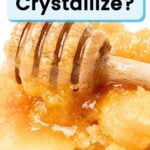
When your golden flowing honey turns into a thick grainy mess-you may be surprised. But, don’t panic this is a natural process called crystallization. Almost all real honey will crystallize to a degree at some time. In this guide, we will explore – why honey crystallizes, what it means and things you can do to slow the process down.

There is a bit of science involved in this transformation process but I promise it is not that difficult to understand. Every jar of honey is a little different so the timing of crystallization varies. Also, whether you have commercial regular honey or raw honey can play a part.
Why Does Honey Crystallize & What is it?
You may hear honey crystallization described in a variety of ways: crystallizing, granulation or “honey that turns to sugar”.
Honey crystallizes because it is a natural, supersaturated solution of sugars. This means that it contains more sugars than water – than would typically dissolve in room temperature water.
Over time, the sugars begin to separate out and form crystals. This is a normal process and is NOT a sign that your honey is not pure. There are some ways to test for pure honey (for fun – but I wouldn’t put total confidence in them.)
The Science Behind Honey Crystallization
The primary sugars found in honey are glucose and fructose. The fact that honey is about 80% sugar is the key to crystallization. These sugars behavior differently in honey.
Glucose & Fructose
Each variety or type of honey varies in the percentages of these sugars. The balance between them is the key factor in the rate of crystallization.
Glucose is soluble in honey but less soluble than fructose. This means is it more likely to precipitate out and form crystals.
This is why honey with a high glucose content (clover honey or alfalfa) are more likely to crystallize than one with a higher fructose level.
Fructose is more soluble and tends to remain dissolved in the water content of the honey. This is why even a jar of crystallized honey normally retains some liquid.
Saturation Point
The sugar concentration intensifies as honey ages. Excess sugar crystals come out of solution and begin to form tiny grainy crystals.
The process begins when microscopic particles, such as pollen grains or air bubbles, act as “seeds” for the glucose molecules to start forming crystals.
Once the process begins, it spreads throughout the honey over time, creating a uniform, semi-solid texture.

Factors that Affect Crystallization Rate
There are several important factors that determine if your honey crystallizes and how quickly it may happen. Some of them can be controlled by us and some can not.
- nectar source
- filtering process
- storage temperature
Nectar Source
When bees make honey, they use nectar from millions of blooming plants. Each type of nectar has a different chemical composition. This affects the color of honey, flavor, aroma and crystallization rate.
Nectar source is a big deal. Higher fructose honey such as acacia, tupelo and even sourwood honey are slow to crystallize and may remain liquid for years.
Filtering & Processing
The journey from hive to jar also plays a role in crystallization rate. Often, honey from large commercial companies are micro-filtered to remove tiny bits of wax, pollen, etc.
This allows them to sit beautifully in a warehouse for months without changing form-without crystallizing. Unfortunately, heat and pressure filtering can damage some of the beneficial nutrients in honey.

Role of Temperature
Storage temperature plays a major influence in the rate of crystallization. This is why it is important to learn how to store honey properly if you want to encourage it to stay in liquid form.
A honey bee colony usually maintains a temp of near 95°F inside their bee hive. At this temperature, the sugar and water balance is comfortable this is called a homeostatic condition.
When removed from the warm hive environment to a cooler temperature (our room temp), the sugar/water balance changes again.
The product works to become “comfortable” – becoming less liquid and more solid to attain the balance.
Very cool temperatures (in the refrigerator?) promote the formation of sugar crystals. Warmer temperatures slow down the crystallization process. That’s why a warm stable location is important.

Is it Still Okay to Eat?
A lot of people throw away perfectly good jars of crystallized honey. It’s so sad and that is not what I want you to do.
If it has been stored in an airtight container and no moisture/water has gotten inside, you can save it.
Learn how to reverse the crystallization process or as we say in the trade – decrystallizing honey without damaging it.
Embrace the Difference
Some people enjoy the gritty texture of granulated honey. But, small fine crystals are more palatable to most consumers.
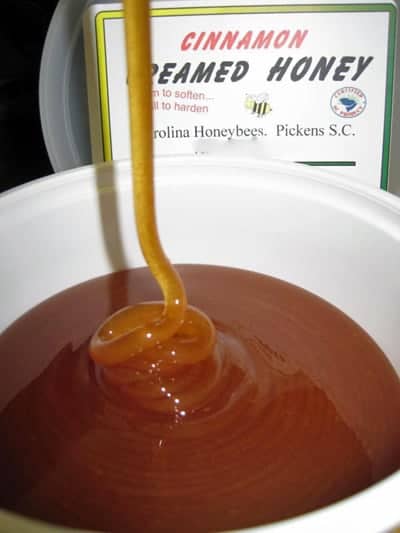
When crystallization occurs in controlled conditions (we control the rate through temperature etc), it results in a thick and smooth texture. We call this whipped, spun or creamed honey.
Learn how to make your own creamed honey. Put it in a pretty jar, add a little powdered cinnamon and you have a special gift idea.
FAQs
Crystallized honey is as nutritious as regular liquid-but not more so.
It usually takes several months for a jar of honey to crystallize. However, some types of honey will thicken much quicker.
Yes, crystallized honey is delicious on toast, biscuits, a bagel or as a topping for oatmeal.
If your jar has a grainy, sour smell, it has fermented and should be thrown out.
This may be challenging as nectar source is one factor in the rate of crystallization. But, by storing it in a warm location, you can slow down the process.
Crystallization is not a sign that something has been added to your honey. Pure raw honey will usually crystallize much faster than regularly processed product. Remember however, that by the same token: crystallization does not prove that it is pure honey either.
Final Thoughts
Unless you have a jar of honey from a nectar source that resists crystallization – you can expect it to happen eventually.
This is a natural process and no cause for alarm. It is still edible and can be transformed back to a liquid state if you prefer.
Once you learn more about the composition of this awesome product, the magic of the beehive becomes even more impressive.
Thank you for the information. Is there any additive one can add to honey to prevent it crystallising without spoiling the honey.
No, this is a natural process of most varieties of honey. Some types may store for years without crystallization but most regular honey does eventually crystallize.
When I heat the chrystalized honey in the pot of water will it become clear again or just liquified.
Heat the pot of water and then place a jar of honey in it. Don’t not heat the water with the jar in there. You may have to stir it several times – don’t get water in it though. And it will eventually return to the same color as before.
How many times can you liquefy honey from a sugary state before it becomes a non_ressurective product?
I think you could indefinitely and it would be slower to crystallize. But you don’t want to overheat it. Beyond a couple of times, you might begin to affect the integrity of the honey but it would not be noticeable.
I love to stir crystallized honey in a cup of hot tea! Yummy
That is yummy
I recieved a small glass jar of what looks like and smells like molasses. Its thicker then tree sap, gritty like sand and practically solid. When I got home and tasted it I was blown away. It tastes like the richest boldest flavored honey on planet Earth (as far as im concerned) Have you had an experience like this or could it be that flavours (like molasses) were added to this jar?
Most likely it is crystallized honey and the flavor has grown bolder over time. This certainly can happen. The popular story you will hear that says “Honey 2,000 yrs old was found in King Tut’s tomb was still edible !..” Well, they didnt say what it tasted like. I would imagine it was quite bold! LOL
So glad to see an article like this. I try to tell people about raw honey and crystallization etc. You explain it so thoroughly. Thankyou.
Thank you so much for taking the time to reach out to me. 🙂
I read many articles on honey and honey bees; this, by far, is the most interesting, fact filled article I have ever read. I’m a new keeper (2yrs), trying to learn all I can. Thank you so much. Keep em coming. Would love to meet up with you one day at a bee convention.
Thank you so very much. I try to create useful content and I hope the info helps people. So glad you liked it, hope to see you someday.
hey hi thanks
charlotte i did not know about this!!!
i did not know you could use honey for things besides CHICKEN NUGGETS!!
🙂
LOL Yes you can, isnt that great! But of course, do continue to use them on the nuggets!
So thankful for this information, so well explained . Bees are a wonderful!
Putting the jar in your closed up vehicle for a few hours on a sunny day will liquify it also.
I do know some folks that have done so. No problem as long as it doesnt get too hot.
Thank you. I’ve always wondered why the honey from my hives has never crystallized
The dishwasher ‘s water temperature gets too hot to liquify crystallized honey.
I agree 100% to my way of thinking. But then we all get into that argument of how hot is too hot. I like to gently warm mine in a hot water bath.
I put crystallized honey in the dishwasher with the dishes and it works fine. The honey is in a sealed preserve jar.
A neat idea I havent thought of !
Thank you for this post Charlotte. I didn’t know there was a honey that didn’t crystallize, I would have thought it was fake if it didn’t.
I am currently doing a study to see if bees will even survive in my area so we can out in a hive or two.
You are most welcome. I have some Sourwood that is 4 years old and still clear. I hope you will be able to have bees !
Thanks for this post! I didn’t know it was still ok! You can bet that I won’t be getting rid of any more of it.
Absolutely, we dont want to throw away good honey. !
This has never happened to the honey that my Grandpa buys but there is always a first time for everything. I would have never thought about honey being able to turn to sugar.
Hi Michelle, It does also depend on nectar source. Sourwood or Tupelo honey is slow to crystalize (if ever) and Privet, Orange Blossom & Clover will crystalize faster !