
Wax Moths in Beehives

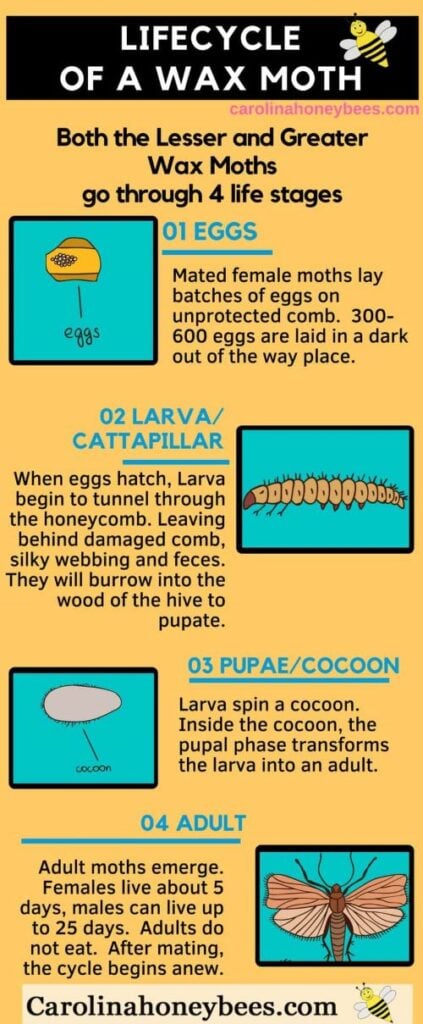
Wax moths in beehives can create a real mess in only a few weeks. Often, beekeepers open a hive to discover damaged comb, webbing and moth larvae crawling on the surface. The good news is that strong colonies are often able to defend themselves against moth infestations. But, weak or struggling colonies may be at risk of failure. Learn how to recognize wax moth problems early and prevent damage before it happens.
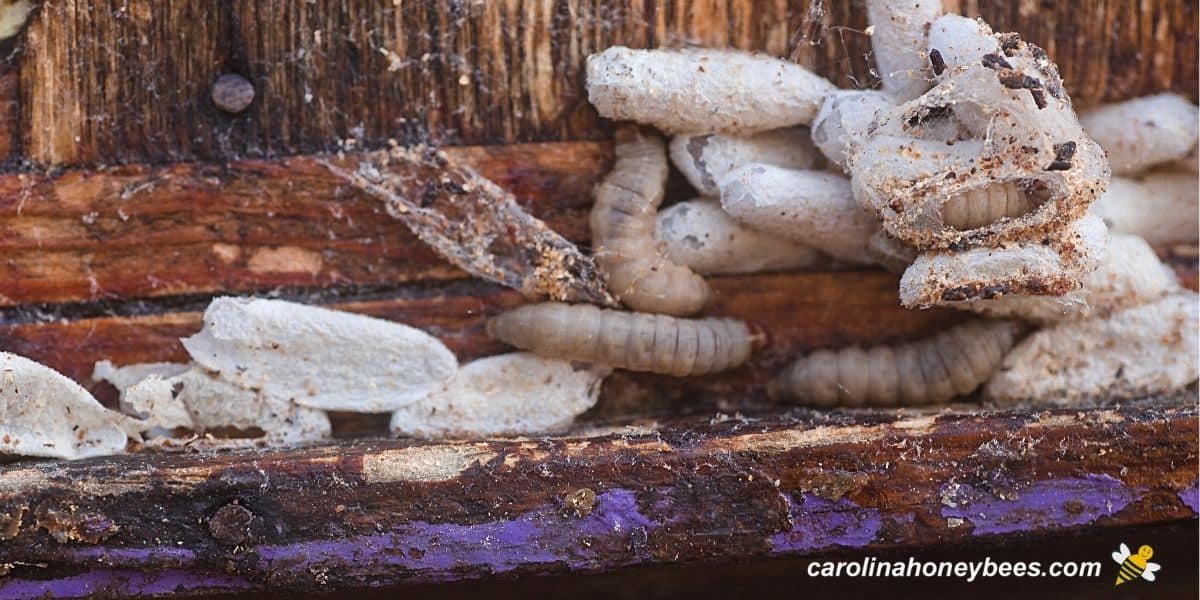
Thankfully, a few simple hive management tasks can help prevent major damage from this common honey bee pest.
Greater vs Lesser Wax Moths

The Lesser Wax Moth (Achroia grisella) – (left) and the Greater Wax Moth (Galleria mellonella) – (right) are both smaller grey-beige moths.
They are most active after dark and often enter the beehive at night attracted by hive odors.
Why Bee Hives Attract Moths
Wax moths are attracted to bee hives because they provide food, warmth and protection for young larvae.
Adult moths do not cause real damage inside the hive. The female moth is looking for a good place to lay her eggs.
Old dark honeycomb is especially attractive because it contains bits of pollen, bee cocoons and other material left behind by developing bees.
Warm weather encourages moth activity, which is why beekeepers must be extra vigilant during Summer.
Populous colonies are better able to chase adult moths from the hive.
Signs of Damage Inside the Hive
You may never see adult moths in your hives. I have found them many times in weaker colonies. But, not seeing them does not mean they have not been there.
What to watch for:
- Webbing & tunnels
- Frass & Debris
- Wax moth larvae and cocoons
- Bald brood & damaged frames
Webbing & Tunnels
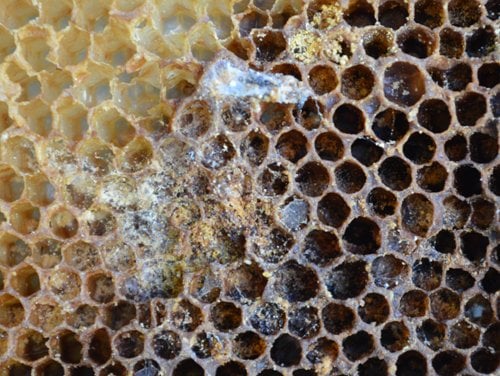
The easiest method of detecting wax moth problems in a hive is the presence of webbing and tunnels in the honeycomb.
Moth larvae leave behind noticeable tunnels with a “spider-like” webbing. This leaves a webby mess for the beekeeper to clean up.
Frass & Debris on Frames
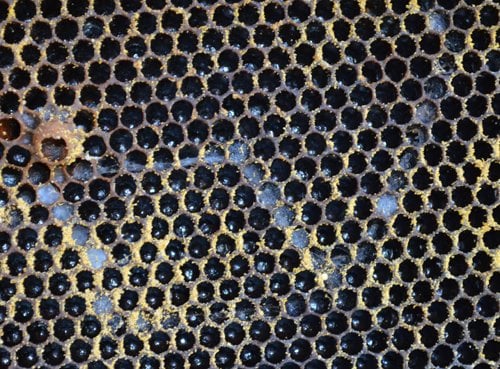
Frass is the excrement of insects. Larval feces (small cylindrical black pieces) can also be seen on the bottom board and in the webbing on the comb.
They look like tiny tootsie rolls – (no I have not).
Wax Moth Larvae & Cocoons
Sometimes, wax moth larvae can be found crawling on the comb surface or the bottom board. The larvae are easily confused with Small Hive Beetle larvae, another bee pest.
But, wax moth larvae create cocoons for their final developmental stage. You can see these anywhere inside the hive.
Bald Brood & Damaged Wood
Wax moth larvae may tunnel through the comb just below the cappings – causing a condition called “bald brood”. This often results in deformed (headless) adult bees.
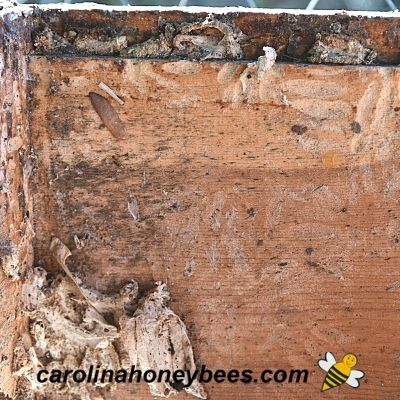
Developing moth larva can damage frames and other wooden surfaces of the hive interior too. They actually chew out an area in which to attach their cocoon.

Get the Buzz on Beekeeping & Life with Bees..
Subscribe to my weekly newsletter. Practical beekeeping guidance, along with honey uses, beeswax projects, and bee-friendly gardening ideas.
This post may contain affiliate links. Carolina Honeybees earns a tiny commission when you shop from our links. See our privacy policy for terms.
Preventing Wax Moth Damage in Your Hives
The best way to treat wax moths in your hives is to avoid letting the situation get out of control. There is no safe chemical that you can put in your hive to kill moth larvae and not damage the bees.
These are some management practices that can help your bees defend themselves against wax moths.
- strong colony populations – manage population all season
- no excess boxes on hive – give bees the room they need – no more
- outside moth traps
Strong Colony Population
Especially during the warm season, you want strong healthy colonies. Lots of bees that cover most of the comb surface are good patrols.
If you split your beehive, or it splits itself by swarming – give them space (bee boxes) based on population.
Likewise, a colony that become queenless may dwindle in population without the beekeeper being aware. Monthly hive inspections are a minimum during warm weather.
Avoid Too Much Space
Avoid adding supers to the hive if the population cannot patrol the comb. We all make this mistake sometimes as we prepare for the honey flow.
Small colonies – (purchased package bees) will need several months to build a good population. This new hive is in danger of wax moth infestations if the beekeeper adds too many boxes at once.
Should You Use Moth Traps?
It is near impossible to keep wax moths out of a hive. In my opinion, traps are an exercise in futility – I have never used them.
Yet, you may live in an area where reducing the number of moths is worthwhile.
One common trap and bait recipe:
Use an empty soft drink bottle – with a one inch hole placed near the slope of the neck.
Fill the bottle with 1 cup of water – 1 cup of sugar, ½ cup of vinegar – add a banana peel. Let this mixture ferment for a couple of days. Then, tie it to a tree near the bee yard.
Experiment with different bait recipes. But don’t expect traps to be the complete answer to moth problems. They will not make up for good hive management.
Managing Moth Problems in the Apiary
In many cases, a serious moth infestation is a symptom of another colony problem rather than the original cause.
Wax moths do not kill established honey bee colonies. But they can make a big mess and cause the bees to leave.
Can a Colony Recover from Wax Moth Damage?
Seeing a moth or a few moth larvae is no cause for panic. This happens even in a strong colony when moths get into the tiny cracks and cervices.
Honey bees can clean and repair minor damage. The beekeeper helps by removing the worse frames and replacing them with new.
Reducing hive space may be necessary too. A 2 deep hive may need to temporarily be reduced to a 1 story deep.
A single deep may need to be in a 5 frame nuc for a while-until the colony population rebounds. This is a good reason to always keep an extra nuc box on hand!
Cleaning Up a Damaged Hive
If you have been in beekeeping for a while, you have likely experienced a box full of moth larvae and webbing. What a mess.
You may find a few bees trying to hang on or the colony may already be dead. If your bees are all gone (or too few to survive), it is best to disassemble the hive for cleaning.
Protecting Stored Honey Supers
One of the biggest mistakes made by new beekeepers is improper storage of honey supers. Your bees did a great job and you want to save all that beautiful wax for them to refill next year.
But, moth eggs can be present on those frames even if you don’t see any. In fact, they do some serious damage to drawn out comb. Learn how to protect it.
Contrary to common information, wax moth larvae can live on pure beeswax. This is another reason to try to keep honey bee brood out of your supers intended for honey collection.
Another option is to treat empty comb with Certan B402 as a wax moth preventative before putting it into storage.
FAQs
Wax Moth larvae eat beeswax, the remains of bee larval cocoons, bee cocoon silk and any bee feces in the cells.
You will never keep them all out of the hive. Instead, help your bees be strong enough to control the problem on their own and provide support with traps, box manipulation etc.
Those white grubs are the larval form of wax moth and will eventually pupate and become grey flying moths.
No, wax worms have small jaws and mouth parts that pose no danger to human skin.
A strong colony will keep them under control. However, once the moth population reaches a certain point – the colony will fail.
No, you should not try to save honey frames infected with wax moth larvae. It is best to freeze the frames for a few days – then save the honey to feed back to the bees.
Final Thoughts
Wax moths are frustrating, but they are usually a sign that a colony needs attention rather than the true cause of collapse. With regular inspections and good hive management, beekeepers can usually keep these pests under control.
The same can be said of Earwigs and roaches. Keeping colonies strong with the proper amount of space to guard will allow the bees to do the job.
Thanks for the lecture about the wax moth. It’s really informative
Hey Charlotte,
I pulled 4 frames off my stash about about a week ago and and did a quick scan of other frames looking for evidence of wax worms, beetles and mites on bees. Everything looked clean and functioning like it should. Finally got around to cutting the wax off this morning and noticed 3 areas the size of a nickel with the telltale webbing. I know those weren’t there when I pulled them a week ago. I would’ve seen them because I would’ve recognized it right off. I’m freaked out. So.. got back in hive this morning and removed the inner queen excluder for winter, pulled a few frames from the brood boxes. Found the back corner has the beginnings of another nickel size webbing area but not seeing worms there or chewed wood. Found only one worm and “took care of it”.
Now I’m second guessing myself. Should I go back in and pull every frame I ncluding brood box for inspection? I pulled the outer frames and one inner frame on each box. 2 broods and one super.
New hive this year due to European bees invading last fall. Wiped the prior hive out clean. The current hive is strong with a lot of bees. They’ve done an excellent job keeping the population high. Not overcrowded, and not too much space. Beekeeping is great when everything falls into place. I’ll be losing sleep worrying…
Hello. I am a new beekeeper and I just went out to my hive and all my bees were gone. There has not been a lot of activity lately but I just figured it was because it was getting colder. There is evidence of wax months. I dont know why they left. They left behind 3 full frames of honey. Is the honey safe to eat? There is no evidence of wax moths on the frames with honeyThanks
As long as you have not used mite treatments while this honey way in the hive, it should be safe to eat. However, why not freeze it and have a boost for next years colony.
I had bee problem in the ceiling of my kitchen. Between my first and second floor we had a specialist come and remove the queen bee. While we were happy to be bee free now it’s been more than a month that we are fighting with moth thinking it is from my pantry or from any kitchen item… yesterday we realized that the flying moths are coming from the ceiling mounted lights .
I read about it and I’m wondering how can I get rid of the rotten hive that is built between my ceiling and the second floor.
There was a little hole outside my house and I know that the bees had access from that little hole all the way to my kitchen ceiling .
Is there anything I can spray all I have to cut completely my ceiling and take care of it that way. I know it will be very costly but I don’t know what else I can do.
Please give me an idea and thank you very much.
Yes, the moths “could” be coming from the left behind bee products. Just getting rid of the bees is never the answer. The honey, comb, dead baby bees etc need to be removed to prevent problems with ants etc. There is nothing you can spray that will make the left behind material disappear. As long as it is in there, things will be looking for it. Do be sure that the outside entrance allowing bees access has been plugged. Otherwise, a new group will move in .
My hive was totally destroyed by wax moths. 🙁 While cleaning it out, I was visited by a few bees. (None were left in the supers) This makes me think they might be close by. If I put a few new frames and foundations in, do you think they will come back? I know it is late (almost November in VA) but want to help them if I can.
No unfortunately, those were probably bees from another hive – even a wild one. For next time, think about what happen to your hive. Why did the population get so low that moths were able to destroy the comb.
Hi, I live in Massachusetts and this is my third year as a “beekeeper” – not all that successful,with one hive. The prior two years the bees left – CCD. However talking to others – it seems that is not that uncommon. This year i decided to add another hive, giving me two. My question is this. One of the hives, is doing fine. The second hive has very few bees, no queen and larvae crawling around. The comb is not gooey nor is there the silk. Is this wax moth damage. What should I do?
It could be moth larva or Small Hive Beetle larva. With few bees and no queen the hive is doomed. If the comb is still in decent shape, freeze the frames for 48 hours and then you can use it later.
Late to the convo here, but I just tore out drawn comb from about 30 stored frames that were infested with wax moths. Do I need to freeze the empty frames before I put new beeswax foundation in them? Where best to store drawn comb?
No I dont worry about frames, I just scrape them good to make sure I have removed any cocoons. For drawn comb, either freeze it and then store tightly or store is in an open airy place.
Hello Charlotte,
Love your blog, it is very helpful and reassuring to new beekeepers like myself. I have been observing moths creeping into the hive at night (with my trusty red light) and seeing cocoons on my corflute. Was starting to panic until I read this post. Last I saw there were plenty of bees so the girls ‘should’ be ok. We are coming into winter soon here in Australia.
One question – does a wax moth infestation smell any different to a healthy hive? I notice a smell at the front of my hive but as a new beekeeper I have no idea what I’m meant to be smelling.
Kind Regards
Kay
You might notice a different smell if there was a big problem. If your hive seems healthy with lots of bees and not obvious dead brood, they may be working some type of plant nectar that is causing a smell.
I’m a newb and have a top bar but I don;t see much info on top bar hives, would you put some info on TB hives TY
It is an area that I would like to expand. Most of my readers do not use top bar hives but I think they are very interesting. Thanks for the request.
I am a new bee keeper and I have read a lot of atricals on the day to day challenge of my new hobby. I have to say that your information that you give to your followers is clear and decide. You have a way of getting to the point and being very informative about your skill. I would love to join you blog and get some more ideas and information about this skill you and others have learned. I have invested a lot in my hives and now that fall has come I have realized that it is now getting to the next chapter and will be a totally new learning curve with the different types of pest and the way that they need to be controlled. Thank you for your time and your help and I look forward to your wisdom.
Thank you Big Rick W
Thank you for the kind words Rick. I try really hard to give clear ideas and allow for each beekeeper to do things their own way when possible. Please sign up for my newsletter to insure you don’t miss updates. If you are on Facebook, feel free to like my business page Carolina Honeybees and join my beginners group. Help for Beginner Beekeepers with Beekeeper Charlotte
I have holes in my wood frames where the larvae dug in. Do I need to fill them? If so, what should I fill them with?
No Missey, I never bother as long as the frames are still strong enough.
We have the same problem but with wood frames what should we do different?
I use wood frames as well. If the comb is not destroyed, just freeze the whole frame and all for a few days and scrape off any cocoons etc that you might see. Then they are fine to re-use. If the comb is over 50% destroyed (on 20% for me), I just replace it with new foundation and use the wax for other purposes.
My weak hive was infested with wax moths. I am a new beekeeper. Can I just scrape the infested wax off of the frame plastic foundation?
Absolutely. That is one advantage to plastic foundation, you dont have to put new wax in the frames.
I have had bees in a chimney for 3 years now. They have rendered the room practically unusable and I could see no way of moving them. Then lately I have had an infestation of wax moth and the bees seems to have disappeared. I do need to clear the chimney of bees and the moths seems to be doing that but how can I make sure that another swarm do not arrive? I will have the chimney blocked up but there always has to be ventilation so bees will get in again. Is there something I can use to get rid of the smell so they do not return? Should I now have the chimney swept and then light a smokey fire or is that dangerous.
I would definitely have the chimney cleaned. Yes, hopefully the cleaning process and some smoke will discourage future swarms.
when transferring bees out of the wild to my bee box
THEY DIE….can u give any possible reason as to why
the least hive i brought home was only 15mins away from my home
First, you must be sure to get the queen bee and she must be well mated. After that, pest management such as developing a mite treatment plant is vital.
Hi Charlotte,
Thanks for your blogs. Wondered if you can tell me if worker bees normally throw out the drones every few weeks during the season? I observed smaller bees stinging bigger bees outside one of my hives yesterday. Figured they were kicking out drones. The bees have been acting weird lately. Not out foraging like usual. We’ve had weird wet & cold weather for two weekends in a row. What do you think?
With the weird weather we have had this year I’m not sure what normal is ! LOL. Seriously, the bees only throw out drones in 2 situations that I know of. One of course is in the Fall. October for me here in SC. They dont need them over winter and dont want to feed them. And the other situation is when resources are scarce. For instance, if I have really hot summer weather with drought – some of my colonies will cast out the drones to save on food. If they need some, they just make some more. No way to know whats happening inside the hive without doing an inspection. Watch out for robbing! That could be what you are seeing. I have a good post on honey bee robbing behavior.