
Feeding Sugar Water to Bees
Most beekeepers will face a situation where they need to feed their bees sugar water. While sugar water is not a replacement for honey, it will sustain a colony that is low on food. In this article, I will share with you how to make sugar water for bees and how to know the right time to use it. I will also explain how I use sugar water feeding in my apiary.
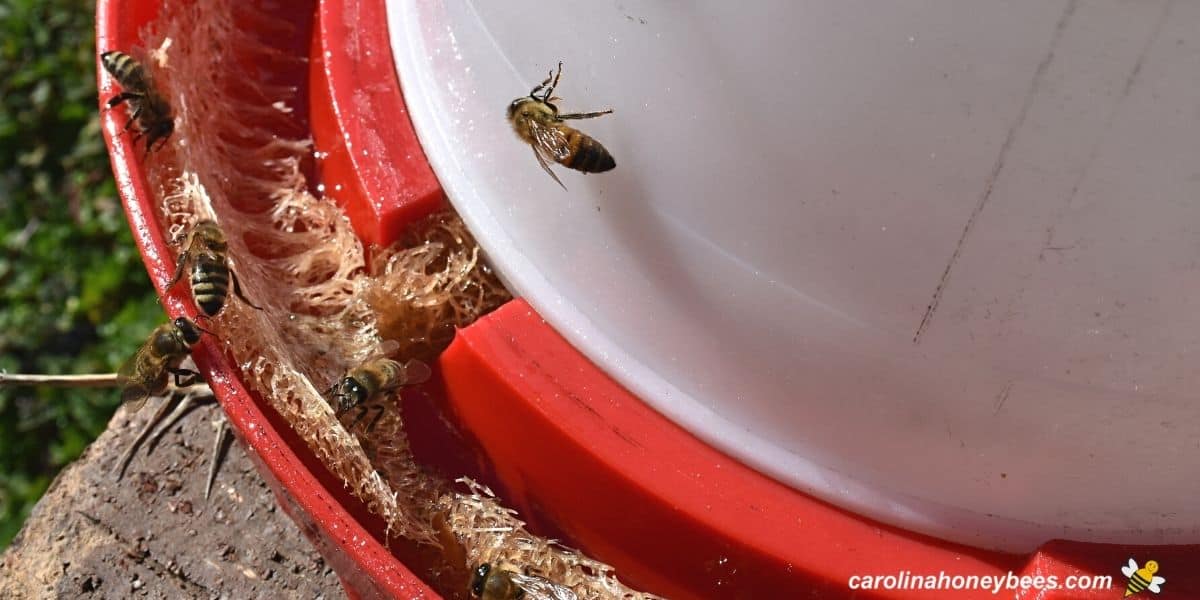
We beekeepers get some funny looks when we are pushing carts full of sugar through the market. But, we know that – done at the right time and for the right reason, feeding is an important part of good hive management.
How to Make Sugar Water For Bees
The first step in making sugar water (or sugar syrup) for your bees is understanding the proper ingredients. It is made by dissolving regular granulated white cane sugar in water. Do not use brown sugar, raw sugar or other ingredients as they may contain substances that will make your colony sick.
Sugar Water Ratios
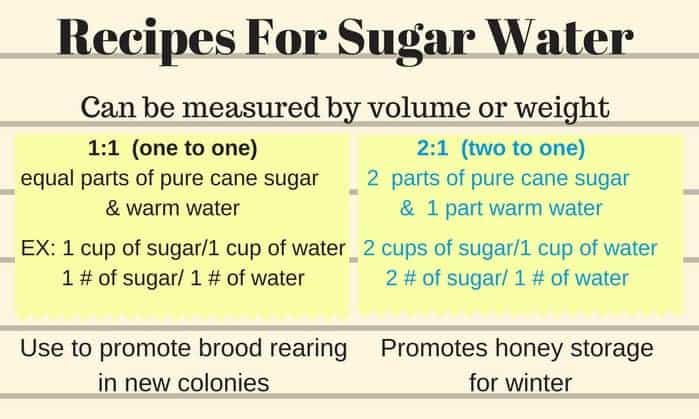
There are 2 basic recipes using when making sugar water for honey bees. Both use the same ingredients (water and sugar).
The difference involves measuring the amount of sugar and water (the ratio) that you add together. You can measure by weight or volume it does not matter – don’t overthink this part.
1:1
To make 1:1 sugar water – mix equal amounts of granulated sugar and water. You can measure with cups or use weight as the unit of measure. It does not matter because either method will result in a 1:1 mixture. Equal parts sugar – water (i.e. 2 cups sugar – 2 cups water).
2:1
A 2:1 ratio contains twice as much sugar as water. For example, 8 cups of sugar to 4 cups of water. When using this mixture, use very warm water to dissolve the sugar easier. However, do not boil your bee syrup, this is not good and it is not necessary.
Recipe for 1 Gallon of Sugar Water
If you only have a couple of hives, you may want to mix up 1 gallon of liquid food at a time. These measurements will get you close to a gallon of liquid in a 1:1 ratio. Do not stress over exact measurements. Even in the field, nectar sources vary a bit in sweetness.
- 10 2/3 cups of granulated sugar
- 10 2/3 cups of warm water
Additives
When mixing up bee syrup (sugar water) I do like to add a feeding supplement to encourage uptake and help prevent syrup from becoming moldy. This is not a requirement – plain sugar water is fine.
You can even use homemade supplement recipes – like using essential oils for bees. These are thought to promote better bee health too. Be cautious, these products are concentrated- add only a small amount.
How Sugar Water Feeding Affects Bees
Why are 2 different sugar water ratios used in feeding bees? I’m glad you asked. While both recipes provide carbohydrates, they have different effects on the honey bee colonies.

Spring Feeding (for Buildup)
Spring is a time of colony growth as bees are busy raising bee brood. Newly started hives are struggling to get their colony established. Spring beekeeping is a busy time for bees and beekeeper.
Feeding honey bees a 1:1 ratio, promotes brood rearing. This thin mixture is closest to the sweetness of most natural nectars.
This same method of feeding 1:1 applies to any time throughout the season when you have a colony in need of food. Perhaps a new split hive could benefit from some supplemental feeding.

Fall Feeding (Food Storage)
As the cold season approaches, it is not uncommon to find hives that are not quite ready for Winter. The secret to Fall bee feeding. is to get out there and get it done in late summer before the weather cools.
The ratio of 2:1 sugar water promotes food storage. This mix is not as likely to encourage brood rearing and more likely to end up stored in comb. If your colonies don’t need extra feeding – that’s great!
Identifying When Bees Need Fed
Aside from seasonal issues, how do you know when your bees need sugar water? As beekeepers, we perform routine hive inspections during the season to assess colony conditions. Sometimes your beehive will tell you when they need help:
Signals from the Hive
- seasonal variations
- hive weight monitor
- hive status
Seasonal Foraging
Every region has an ebb and flow of nectar and pollen producing flowers. Constantly monitor food stores and incoming nectar. In case your bees need help due to a nectar dearth.
Checking food stores during this time and possibly feeding to help build bee populations may be advisable.
Hive Weight
I am not one of those beekeepers who is a master at judging colony weight – but some folks can. If you gently lift the hive from the back (just a bit) you can tell if it is “light or heavy”. If all the hives in your apiary are heavy except for one – you may need to feed those bees sugar water – at least a few gallons (yes-gallons).

Hive Status
The most important aspect of feeding bees has to do with hive status. Regardless of weather and forage, most new hives with a freshly installed package of bees will benefit greatly from supplemental feeding.
The same also applies when beekeepers split their hives to create new colonies. Having extra food is a big bonus that the bees will make use of at night and on rainy days.

Get the Buzz on Beekeeping & Life with Bees..
Subscribe to my weekly newsletter. Practical beekeeping guidance, along with honey uses, beeswax projects, and bee-friendly gardening ideas.
Expert Tips
If you discuss your methods of feeding sugar water to your bees, be prepared for some criticism. Some beekeepers feel that you should never feed your hives, period. Others recognize the importance of feeding bees when hives conditions warrant.
No matter what you choose, be prepared to have some well-meaning beekeepers at the local beekeeping association meeting to tell you that you are wrong!
- supplemental feeding does not take the place of natural nectar and pollen
- do not give bees sugar water without a reason – you can overfeed
- always try to evaluate why the colony needs sugar water (weather conditions, low population, etc.)
- The biggest mistake made by beekeepers is failing to feed a new colony long enough.
FAQs
Only feed sugar water to beehives that are in need of extra nutrition. For newly established hives, feeding for a few weeks gives them a big boost.
Even healthy established bee colonies can experience food shortages. They may be victims of a lack of forage in the field such as that caused by a drought or the field force of bees may have been lost for some reason.
Feeding bees does not make them lazy. In fact, honey bees prefer natural nectar when good sources are available. They may ignore your sugar water if food in the field is plentiful.
There will be times when you should stop feeding bees sugar water. These include the cold months of Winter (unless you are in a very warm climate) and when your honey collection supers are on.
The bees will use any nectar (or nectar-like substance) to make honey. Honey produced from sugar water instead of nectar – that’s a no no. And, its not real honey.
Yes, sugar water you make for your bees can get moldy. Only make the amount your bees can use before it gets stale.
Final Thoughts
Making and feeding sugar water for bees is a lot of work and expense (if you have more than one hive). You should not have to feed every colony all season. If this is happening, something is wrong. How much extra sugar water your hives require will depend on your climate and other conditions.
Is it OK to open feed 1/1 mix this time of year? With the Hurricane last week I am starting to notice some robbing . Most of the goldenrod that was blooming has been affected and bees are feeding very aggressively on my 5 gallon bucket feeders I started yesterday.
Sure its okay, and you may consider setting up several 2 gal (or 1 gal buckets) instead of just 1 . Spread the population around.
I was wondering when you need the ventilation bottoms for your hives
I leave ventilated bottom on all year. If we have a really cold front in Winter. I slide the grid boards inside.
Hi Charlotte,
I am in a neighboring state, Ft. Bragg, Nc area. I enjoy reading your posts on bees. Very informative. Haven’t read all but working on it. I am a second yr bee keeper. My 1st year didnt work out so well. 3 packages and a swarm. They either died or absconded. Also the fact that my job was keeping me on the road 99 percent of the time didnt help either. Along with someone who was also a new bee keeper taking honey from them, the winter stores I’m guessing. But I was not discouraged,. I started over with 1 package and 2 nucs. And so far so good. As I was told when I got my nucs, be nice and give them a Christmas gift, a sugar patty also a valentines gift….lol. The winter stores will be left alone this time, being I am here permanently now. I am still feeding sugar water, 1 to 1 mix, in half gallon jars on boardman feeders. So my question is, should i stop feeding during winter mths, since the colony will downsize by kicking out the drones, and just keep an eye on their stores and feed them as needed or keep feeding as long as they are taking it.
We want our bees to have enough honey stored for winter well before Winter arrives. Feeding in winter should only be an emergency or extra precaution plan. So, I suggest – decide how much honey (how many boxes etc) bees need in your area. Feed the bees until you have that amount of stores. Dont forget to manage mites.
Hello, I live in Georgia and we have had a very wet summer. Can a lot of rain affect honey production? I have checked my hive and there are lots of bees, but no honey.
Absolutely, my bees dont fly very much in the rain. Also, sometimes the rain will wash nectar out of the bloom. Do you subscribe to my newsletter? Would love to have you.
I just took some honey out of my hive, only 4 frames and left the rest to the bees. I hve heard that a strong hive sucvh as mone you can harvest in September. Can I feed my bees now and then harvest in September? I hae one small honey super on now…
How much honey you took is not as important as how much you left. In my area, I have no Summer/Fall flow. Local conditions where you live will determine 1)How much honey your bees need for Winter and 2) Will there be enough forage out there for them to get what they need. I dont take any honey until my bees have one full shallow for themselves. How much you need to leave will depend greatly on your location.
Hi
im a newbee being mentored by a local beekeeper and my hived swarmed up above the hive in a tree about 40ft in the air and came back to hive i was thinking of stop feeding them sugar water cuz i was going to add the super to it
is that going to upset them
Pete from Maine
Do they have enough comb built and honey filled for the Winter? Here in SC, I tell my students to feed their bees until that goal is accomplished. Your local forage will factor in of course but in my area, a swarm that is not fed doesnt have a good chance of being ready for Winter by October.
I have several bee hives in South Texas where it has been very hot and dry this summer. I have put the supers on but am concerned that they will still need to be fed. What is the concern with feeding with supers on. I don’t want them to die or leave. I do have a water source close to the hives
There is no reason to feed with honey supers on for you. It would not be real honey. Bees make honey from plant nectar. They will convert sugar water into a honey-like substance but it wont be real honey.
Hello Charlotte,
This is my first year for keeping bees. I live in rural North MO and discovered a colony in a tree not too far away from my home. I decided to set a swarm trap in the trees behind my house and attempt to catch a swarm instead of buying a nuc or package. I started feeding sugar water in my back yard with the idea that it would promote a rapid spring built-up in the bee tree and they would need to swarm out. They were taking 2 qts of 1:1 a day! It must have worked or they did so naturally, who knows, I caught a swarm in the trap on my first try and now I have a new hive. I successfully transferred them to a hive on the 18th of June. A local bee keeper told me I should now stop feeding and let them do their own thing. He believes that sugar water will sit in the cells and go bad unless it is treated. Because it was very cold through mid May and we have had very hot and dry conditions here for early summer I am still feeding them and added a protein patty to boot. I fear that since they have gotten a late start in the season they are at a disadvantage and might not be able to sufficiently build-up their numbers and stores before winter. I will feed them this way all summer if that’s what it takes for them to survive. Is it factually true that sugar water stored in the cells will go bad if it is not treated before feeding?
After I transferred them I put a qt jar of sugar water with punched lid upside down over the hole of the inner cover protected by a deep box and lid and left it there for about 4 days. I thought that maybe that was too long for it to be used without it going bad, so I change it out with a fresh jar. This afternoon when I checked on them I noticed crawlers in front of the hive. I counted a couple dozen of them. Have I made them sick from the sugar water or could the colony they came from have been sick in some way? They seem to be very lively, even a bit defensive. As a result of my own stupidity I have been stung by them twice already.
Best Regards
Hi Dan,
You can rest easy as your sugar water would not have caused any problems with your bees. In fact, once the bees take the sugar water in and begin the conversion process to honey, you have no worries about it spoiling. While honey made from sugar water will not contain all the essences and micronutrients of honey made from plant nectar, it will not spoil in the comb more than any other kind. If they were mine, I would continue to feed as much as they will take it because they have a lot of work to do before winter.
The crawlers you are seeing as most likely a result of mites (viruses) etc unless a few happened to get into a pesticide.
I think you are on the right track, listen to your gut. Good Luck
i have 30 colonies apis cerana nd after several months it was turned to 40 by dividing but now only 29 volonies left what causes the bees to get awau from colonie
Many factors can cause problems. Lack of forage, problems with your queens, mites or other pests.
Hi charlotte and hi to all beekeepers.
I am a new beekeeper. From algeria (north africa).
I bought seven hives last year ( 2017) and i want to get good honey this year(2018) for human consomption.
This year ,the winter is long,it means , we are in june and still have rain and cold days.
The problem is that bees started Storting honey from nature, and the weather changes to cold,
So please, can i give them some sugar water just to est it not to store it? If yes, how much the ratio of sugar In water that must not be exceed juste to eat it. Know that i stopped feeding them.
Thkx so much.
Best regards
Local conditions are important. You can feed the bees anytime that you do NOT have boxes on for human consumption.
I am a newbie with a tbh and my bees are a new package (1 mo). I live in N TX and they are still going through a quart every 2 days. I’m told when they lose interest to stop, but they are not losing interest even though they are drawing comb like gang busters! I don’t know if I should drop down, stop and see or continue. I’m not concerned with human consumption, just keeping them fat and happy until something changes. They are great foragers and there is a lot of pollen comb. Should I continue for now?
I would continue. A tbh is a bit different – I dont know how much you need for Winter in your area. But since this is a new package of bees, I would not be quick to remove the feeder, especially since everything seems to be going so well.
I’m getting my very first package this weekend. I plan on using 1 gallon baggie feeders. My only concern is not being able to open the hive for the first 5-7 days. I’m not sure if 1-2 bags will last until I can open and check on the hive.
I used to use gallon baggies and liked them quite well. But you are right, they are a pain if you need to do inspections. You must be using a shim? If you lay the bags on the top bars you need a shim to hold the inner cover off the bag. IF you are putting them on the inner cover, you need a shim to hold the top off the bag. A bag or two would be fine for 5 days and if you put them on the inner cover you might be able to carefully move it (and them) in a few days if you need to.
We had our colony collaspe. I am having to give sugar water. The bees are going through a quart jar in two hours, should I be giving more.
Sandra, Usually when we say that a colony has collapsed it means it is dead. So I’m thinking that you have a weak colony or one that is low on food. What do to depends on where you live. It is 27 degrees at 3 PM in my area right now. But in general – when I am feeding bees that need fed, I would need more than a quart. Maybe use 2 or even 3 quarts at a time.
We have a new hive (local cut out) that is trying to produce a queen. They are eating a quart of 1:1 sugar water in less than 24 hours. The other two hives (Italian, with queens) are not eating their water that fast. Could the new hive be getting robbed even though there is still clover and they sugar water available to the other bees?
They could be, do you see fight and wrestling at the front? Also, since their hive life has been disrupted by the cut out and move, they may not be taking advantage of the local nectar as well as the others. I would make sure the entrance of the cut out hive is reduced some to help them protect against robbers.
Why does feeding sugar water to a colony make the honey unsuitable for human consumption?
Feeding sugar water while your honey collection supers are on will result in bees making sugar water honey. Real honey contains enzymes and all kinds of neat things left over from the harvested plant nectar. Sugar water is as close to honey as we can get for the bees but it is not really honey. Feed bees when you need to but not when the supers are on for your harvest.
Thanks very informative always wondered when to stop feeding .. Old hive had swarm queen cells– I split/ two bottom deeps with queen excluder on top added two mediums w/ another queen excluder and another two shallow w/drawn frames.
lower frame had brood and bees and honey from original hive. whats your opinion and what should expect. Thanks Santo used total 6 two/two /two
Its important to match the size of your hive (space inside) to the population of the colony. Unless you have alot of bees that sounds like alot of space for them to protect. After splitting a hive, always check in a couple of weeks to see if you have a laying queen in each part.