
Feeding Sugar Water to Bees

Most beekeepers will face a situation where they need to feed their bees sugar water. While sugar water is not a replacement for honey, it will sustain a colony that is low on food. In this article, I will share with you how to make sugar water for bees and how to know the right time to use it. I will also explain how I use sugar water feeding in my apiary.
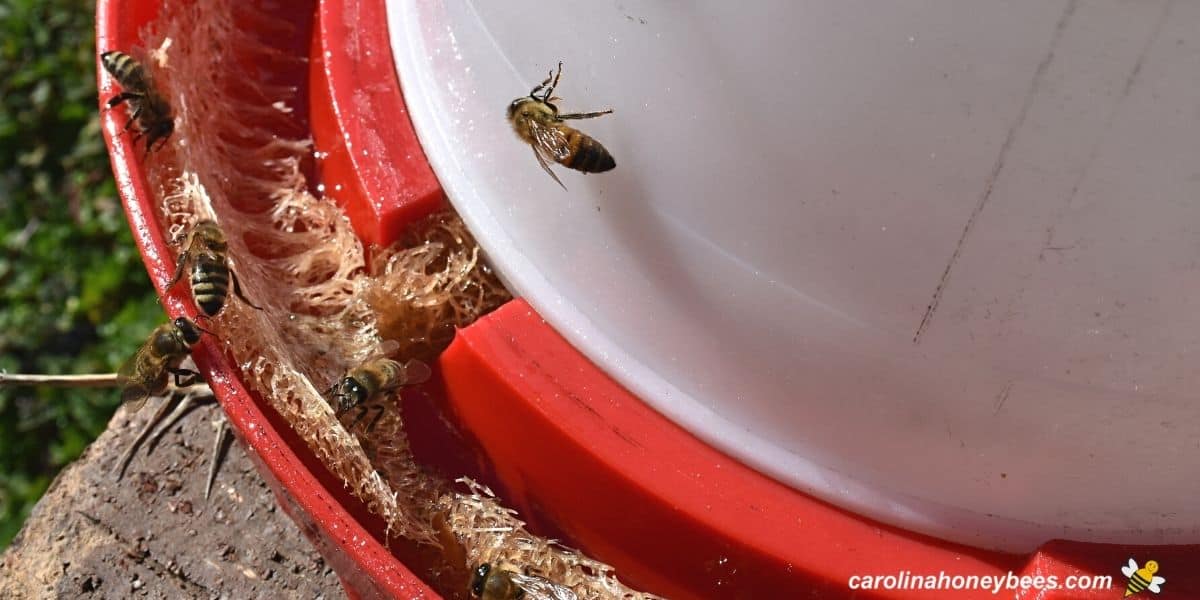
We beekeepers get some funny looks when we are pushing carts full of sugar through the market. But, we know that – done at the right time and for the right reason, feeding is an important part of good hive management.
How to Make Sugar Water For Bees
The first step in making sugar water (or sugar syrup) for your bees is understanding the proper ingredients. It is made by dissolving regular granulated white cane sugar in water. Do not use brown sugar, raw sugar or other ingredients as they may contain substances that will make your colony sick.
Sugar Water Ratios
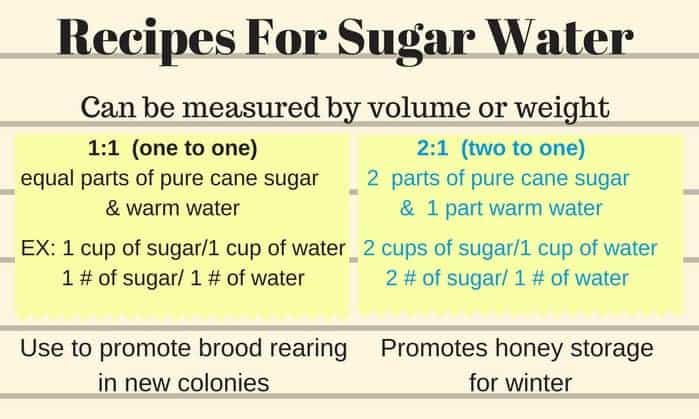
There are 2 basic recipes using when making sugar water for honey bees. Both use the same ingredients (water and sugar).
The difference involves measuring the amount of sugar and water (the ratio) that you add together. You can measure by weight or volume it does not matter – don’t overthink this part.
1:1
To make 1:1 sugar water – mix equal amounts of granulated sugar and water. You can measure with cups or use weight as the unit of measure. It does not matter because either method will result in a 1:1 mixture. Equal parts sugar – water (i.e. 2 cups sugar – 2 cups water).
2:1
A 2:1 ratio contains twice as much sugar as water. For example, 8 cups of sugar to 4 cups of water. When using this mixture, use very warm water to dissolve the sugar easier. However, do not boil your bee syrup, this is not good and it is not necessary.
Recipe for 1 Gallon of Sugar Water
If you only have a couple of hives, you may want to mix up 1 gallon of liquid food at a time. These measurements will get you close to a gallon of liquid in a 1:1 ratio. Do not stress over exact measurements. Even in the field, nectar sources vary a bit in sweetness.
- 10 2/3 cups of granulated sugar
- 10 2/3 cups of warm water
Additives
When mixing up bee syrup (sugar water) I do like to add a feeding supplement to encourage uptake and help prevent syrup from becoming moldy. This is not a requirement – plain sugar water is fine.
You can even use homemade supplement recipes – like using essential oils for bees. These are thought to promote better bee health too. Be cautious, these products are concentrated- add only a small amount.
How Sugar Water Feeding Affects Bees
Why are 2 different sugar water ratios used in feeding bees? I’m glad you asked. While both recipes provide carbohydrates, they have different effects on the honey bee colonies.

Spring Feeding (for Buildup)
Spring is a time of colony growth as bees are busy raising bee brood. Newly started hives are struggling to get their colony established. Spring beekeeping is a busy time for bees and beekeeper.
Feeding honey bees a 1:1 ratio, promotes brood rearing. This thin mixture is closest to the sweetness of most natural nectars.
This same method of feeding 1:1 applies to any time throughout the season when you have a colony in need of food. Perhaps a new split hive could benefit from some supplemental feeding.

Fall Feeding (Food Storage)
As the cold season approaches, it is not uncommon to find hives that are not quite ready for Winter. The secret to Fall bee feeding. is to get out there and get it done in late summer before the weather cools.
The ratio of 2:1 sugar water promotes food storage. This mix is not as likely to encourage brood rearing and more likely to end up stored in comb. If your colonies don’t need extra feeding – that’s great!
Identifying When Bees Need Fed
Aside from seasonal issues, how do you know when your bees need sugar water? As beekeepers, we perform routine hive inspections during the season to assess colony conditions. Sometimes your beehive will tell you when they need help:
Signals from the Hive
- seasonal variations
- hive weight monitor
- hive status
Seasonal Foraging
Every region has an ebb and flow of nectar and pollen producing flowers. Constantly monitor food stores and incoming nectar. In case your bees need help due to a nectar dearth.
Checking food stores during this time and possibly feeding to help build bee populations may be advisable.
Hive Weight
I am not one of those beekeepers who is a master at judging colony weight – but some folks can. If you gently lift the hive from the back (just a bit) you can tell if it is “light or heavy”. If all the hives in your apiary are heavy except for one – you may need to feed those bees sugar water – at least a few gallons (yes-gallons).

Hive Status
The most important aspect of feeding bees has to do with hive status. Regardless of weather and forage, most new hives with a freshly installed package of bees will benefit greatly from supplemental feeding.
The same also applies when beekeepers split their hives to create new colonies. Having extra food is a big bonus that the bees will make use of at night and on rainy days.

Get the Buzz on Beekeeping & Life with Bees..
Subscribe to my weekly newsletter. Practical beekeeping guidance, along with honey uses, beeswax projects, and bee-friendly gardening ideas.
Expert Tips
If you discuss your methods of feeding sugar water to your bees, be prepared for some criticism. Some beekeepers feel that you should never feed your hives, period. Others recognize the importance of feeding bees when hives conditions warrant.
No matter what you choose, be prepared to have some well-meaning beekeepers at the local beekeeping association meeting to tell you that you are wrong!
- supplemental feeding does not take the place of natural nectar and pollen
- do not give bees sugar water without a reason – you can overfeed
- always try to evaluate why the colony needs sugar water (weather conditions, low population, etc.)
- The biggest mistake made by beekeepers is failing to feed a new colony long enough.
FAQs
Only feed sugar water to beehives that are in need of extra nutrition. For newly established hives, feeding for a few weeks gives them a big boost.
Even healthy established bee colonies can experience food shortages. They may be victims of a lack of forage in the field such as that caused by a drought or the field force of bees may have been lost for some reason.
Feeding bees does not make them lazy. In fact, honey bees prefer natural nectar when good sources are available. They may ignore your sugar water if food in the field is plentiful.
There will be times when you should stop feeding bees sugar water. These include the cold months of Winter (unless you are in a very warm climate) and when your honey collection supers are on.
The bees will use any nectar (or nectar-like substance) to make honey. Honey produced from sugar water instead of nectar – that’s a no no. And, its not real honey.
Yes, sugar water you make for your bees can get moldy. Only make the amount your bees can use before it gets stale.
Final Thoughts
Making and feeding sugar water for bees is a lot of work and expense (if you have more than one hive). You should not have to feed every colony all season. If this is happening, something is wrong. How much extra sugar water your hives require will depend on your climate and other conditions.
Hi
Whens the best time to start feeding 2.1,im feeding them 1.1 at the moment and have just placed my second deep,i got the bees at the end of july,there doing well at the moment but want to ensure they make it through the winter 👍
When the colony has pulled most of the comb needed and the population is good – 2:1 promotes honey storage more so than growth.
Hi i am getting 2 nucs. Should i start with two brood boxes?. I am in sw va. If so when to put the super on for their food for winter? July? An mite treatment?
No. Only use 1 brood box in the beginning until you have 7-8 frames out of 10 pulled out and in use.
Hi Charlotte, What is your opinion on Fructose 55? And where would you recommend buying large quantities of Sucrose syrup?
Large apiaries have to do things differently. I have no idea where you could buy sucrose syrup. I make my sugar water a few gallons at a time.
Hi Carolina,
My name is kat and I have a question that needs some help if you don’t mind. I have a honey bee that comes on my back porch doesn’t go to my flowers but comes to my rug. The bee comes and goes but I have no clue what’s going on with the bee. I don’t know if it’s getting stuff from the rug far as water goes. I do have planets and yes when I water them the rug gets wet. If the bee does go to the flowers I never see it. But last year I was having the same issue but last year I didn’t have a rug. I want to help the bee but clueless on what to do. Some people have said get more flowers some say it might be tired some have said it might be getting neutrals or minerals from the rug and some say get a cap from a bottle and put water with rocks in it. The bee is welcome it doesn’t seem like it wants to harm me but I know not to make it mad or scared. As I write this I have a cap of water sitting on the rug but it hasn’t gone to it I m making sure everything is ok not gonna leave the cap out. I just want to help but I don’t know how or where to begin. Or don’t know if the bee needs help or not. Can you please help me to understand what to do? Cause I m so lost on everything far as helping the bee out. Thank you so much for reading this and taking the time out to help me
Hi Kat, I agree with others that their is something in that rug that is attracting her. She must like “rug scented” water. No, she is not likely to sting you as long as you don’t step on her. However, you dont want her to come back with 20 friends! 🙂 If it were me I would probably wash the rug well well and let it dry completely, find a way to water the plants without getting it wet. And, if you really want to… create another water source for the bee girls. They need a shallow safe drinking place.
Thank You I was thinking of starting up a colony in the spring.
That’s awesome. Now is a good time to start learning. Consider my online beekeeping class – on one of some kind – it will be a big help.
Hi Charlotte,
I have a Spring swarm hive that is failing. I decided it was queenless so i purchased a new one but I think they killed her. My neighbor had a small swarm on his fence in 100 degree heat so I captured them in a small nuc. I combined it with the failing nuc and a newspaper layer a few days ago. Is it safe to assume the swarm had a queen? I am giving them a few days to adjust before I tidy everything up and get rid of extra frames and check for a queen. This hive also had wax moths and we are fighting them too.
Wax Moths are a symptom of a problem. They cant take over a strong colony. With bees anything is possible. Most likely the swarm has a queen with them. You will have to check in a while and see how things worked out. Also, be sure to read my article on wax moths so you can understand why they become a problem.
We look like we have starving bees but have had a top feeder with 1-1 syrup on top of the hive for 2 weeks now. It is a jumbo feeder with “two cups” for the bees to get access. The bees do not appear to have tried to drink this, it’s on a crown board above the brood chamber. We have other colonies with slightly different feeders who seem to have no issue accessing their supplies and are happily drinking the same homemade syrup. How can we coax the bees into the feeder?
Once in a great while, I run across a colony that just will not use the top feeder. Have you tried dribbling a little bit of sugar water down through the holes that the bees would enter? Sometimes that helps bees figure it out faster.
I enjoyed reading about bees. I have a lemon mint garden that comes back every year for a out 3 years. I was concerned about people not seeing honey bees so I made a point of leaving the garden undisturbed. It is outside my home office windows and I really enjoying watching as I work. They are busy ALL DAY. Lots of them. Don’t know where the hive is. I live in a wooded neighborhood with lots of natural area so probably an old tree. I put out a hummingbird feeder on my deck beside the garden. The the bees and hummers (only two every year) share the sugar water like good neighbors should. I have lots of deer w/babies, lots of birds, possum, raccoons, an occasional fox. Nature is so wonderful. My husband has health issues. Filling the feeders, and looking forward seeing them waiting for him to come everyday has helped his health.
That’s awesome. Sounds like a little oasis of life!
I’ve got a couple of really strong hives. In hopes of not killing two hives with one stone, I’m going to take a stab at splitting one of them. Short of relocating the queen and a few frames of brood, is there anything else you recommend? Thanks for your assistance.
You will need to feed very well. Try to take a bit from each hive and watch to make sure everyone is about to adjust.
As you live in a somewhat similar area as I, central NC, what is your opinion of the dearth period and will I be able to rely on my girls finding food in the fall as opposed to feeding them throughout?
Totally weather dependent. If my girls have a full honey super for themselves when I pull the Sourwood. I will monitor them and feed if needed in September (or before). Can depend on a Fall flow here.
Hello Charlotte,
O I have soooo many questions. (Can you tell I’m a desperate newbie, LOL).
I just acquired my two packages of bees three weeks ago. One package of Italians and one package of Carniolans. I am having a few questions or maybe they’re problems. I am using frame feeders and have been feeding both hives sugar water. So far, they seem to be doing very good.
My Italians have made comb on 7 1/2 frames out of 10. I’ve not seen my queen as of yet but there are lots of larva. It looks to be about 3 1/2 to 4 frames of larva. I even saw a baby bee hatch out today. JOY! JOY! She was just sooo cute! Anyway my concern is that they seem to be building what I call “wonky comb”. Some of the comb is flush with the frame and in other areas they have attached the comb to the next frame connecting the two frames. In the last two weeks I have even found where comb was built on the screen of the baseboard and even a long one in the feeder. Is this normal? I have checked, rechecked, and triple checked that the hive is level and perpendicular on the top, bottom, and on all four sides.I have two frames that are completely “glued” together and can not remove one without tearing the comb all apart. I have removed the weird little shaped combs off the baseboards and anywhere else I might see them some place other than on the frames. I call them weird shaped because they look more like a paper wasp nest instead of honey comb and are very deep, some cells are up to an inch deep. I know they’re bee comb because they have had “sugar water honey” in them. I am getting ready to put another deep box on top but before I do that I am wondering if there is something that needs to be done to correct this behavior.
My Carniolans, on the other hand, has a completely different hazard. I think my queen is gone. After 7 days I checked to make sure she was out and going. I found her right off the bat on the middle frame and it looked like she had laid a few eggs. But last week when I popped the top to check my brood I found two queen cells already capped and one cell formed but no larva yet. I couldn’t find my queen so I think she’s gone. These cells are are located in the middle of the frame and not on the bottom. I am told that if cells are in the middle. the colony is replacing a queen and if on the bottom of frames, on the underside of the cover, or on the inner cover then they are wanting to swarm. I hope this is true. I have a swarm box close at hand just in case they decide to swarm. I have heard that Carniolans have the propensity to swarm and I have been keeping a close eye on them. Today when I checked to see how they were doing there were 4 cells. I pulled one cell and opened it up to see what was inside. I’m not an expert by no means, but it looked like a queen to me. The larva (pupa) was a lot bigger than the worker bees around it. My conundrum is this. Do I pull another queen cell out then let the other two queens fight it out when they emerge? Or do I need to pull them all and scurry around trying to find a queen? I can get a local queen but all they have around here are Italians and ferals. ( Apparently the locals are afraid to try anything else.) I have an Italian hive next to them so I figure sooner or later they will mix any way.
I’ve been just pushing the inner and outer covers over just enough to put feed in the frame feeders every three days and only actually taking the covers off once a week to see how the bees are doing. I,m trying not to bother them any more than I have to so they can work in somewhat peace. Since it takes 16 days for a queen to emerge, I am figuring these queens will be hatching in about 5 days or so. I do hope they’re queens and not laying workers.
As to feeding, I’ve got questions on that, too. I live in southeast Kansas and it has been raining almost daily for about six weeks so I know I’m going to have to feed for quite some time.We’ve been lucky that it has been raining mostly at night and during the day the temps have been between 7 and 85, so I know and have seen the bees out gathering nectar. Since I am about ready to add another super to the Italian brood box, do I still need to check the bottom box? If so won’t I lose some bees in the grass or heaven forbid my queen. (It’s much easier to see a queen in a still photo than it is when she’s scurrying around with the other bees,LOL)
Since this is my first year I am not planning on any harvest whatsoever. My plan is to hopefully have two deep and if possible a medium box going into winter so they will have enough storage that I won’t need to feed through the cold months. My luck I’ll freeze them if I have to feed this winter. I am planning on feeding lots of sugar water this year! If I need to check all boxes each week then this will change my whole set up that I have in mind. I thought initially I would only have to check all the boxes in the fall and next spring. I need help, suggestions,comments,mentoring, anything and everything.
I have a bushel basket of questions but I’ll not overwhelm you today with all of them. I am loving your site for all the info. I belong to a Bee Club but am finding that most of the members are like me … newbies. There are three members who have had bees for 2-3 years, two that have had bees for 10+ years, and the other 25+ members are like me – first timers. Therefore when I ask questions I get blank stares, answers that make no sense, or sighs of irritation that I’m asking questions again. I’ve asked the two most versed members if they would mentor me but they are so overwhelm with all the other newbies and taking care of their own hives that I have not gotten very much help there either. Of course I am trying new things that aren’t standard here – Carniolan bees, a flow hive, and a jar super.
Thanks for taking the time for me to bend your ear.
Oh my goodness, no way I can answer all of that here but I admire your enthusiasm. You are doing well to feed them. I remove any wacky comb before it gets too big. Colonies sometimes replace their queen after being moved – I’ve found it best to let them work it out for a few weeks before I bother them. Beetles can be a summer long problem here. Nothing works perfect – just keep on top of it. If you havent already, consider my beginners class – it will answer alot of newbie questions and help make sense of things. Best of Luck – have fun. https://carolinahoneybees.com/beekeeping-class-combo-deal/
Charlotte
I use a top feed and installed my bees yesterday. I put around 1 Gallon into the feeder. Will that be enough for the first week. I don’t want to interrupt the collony.
I’m located in upstate SC
With a top feeder, refilling wont disturb the bees. They make drink it really fast or not if they are finding natural nectar. If they don’t take it or as slow to…. give them half as much next time and check every couple of days. When the natural nectar flow stops, they will be glad of it.
Hi Charlotte, Great website, thanks for sharing all your experience, especially with us newbees. Question: you mention to stop feeding sugar water when we put our supers on. We don’t plan on harvesting any honey this season since this is their first year, and we want to make sure they have enough to carry them through our cold montana winter. That being the case, is it still okay to keep feeding them after the supers are on? Thanks!
Yes, as long as you can in some way be sure to remember that they will not be REAL honey.
Thank you for all the great information. I have only been on your e-mail list for a few weeks but have learned a lot. My bees for two hives arrive this Saturday. I think I have everything ready. I am so excited.
Thanks so much David! It is going to be a very exciting day! Make a plan, have the stuff you need gathered and have fun.
I have a robust hive of Carnolian bees entering its third Spring. They made it through a colder than normal Kansas City winter. This Spring I am going to be starting a 2nd hive right next to this first hive. I will be getting a 5 frame nuc of Minnesota hygienic Italians at the end of April or early May. With a new hive placed right next to a robust established hive any suggestions to minimize the chance of robbing?
Sure thing, start off with the entrance greatly reduced and keep it small until the smaller one builds up. Consider sharing brood and giving the nuc a few frames of capped brood from the other hive – that will equalize their strength.
Hi. I started bee keeping this past April. I fed sugar water and all seems to be going great. I added a second deep body when they appeared to require it. I did not add a honey super as I wanted the bees to have enough honey for winter. I stopped feeding sugar water in late August. My question is when should I start feeding again. The bees and I live in North Central Texas.
Buddy, it is VERY climate dependent. Ideally, you would not have to feed an over-wintered hive that still has plenty of honey stored. If your bees have enough food to last until your “flow” starts – you dont have to feed unless you want to encourage them to build up brood. Of course, don’t feed once you add a box for you.