
How to Buy Bees for Your Hive
Becoming a beekeeper is an exciting time, but before you can enjoy the adventure to its fullest, you need bees for your hive. Buying honey bees is the most common way for beginner beekeepers to start. But this can be a bit confusing – you cannot just swing by the farm store and pick up a colony (at least not usually). Orders for bees often take place weeks or months before their actual arrival. Knowing when and where to order bees helps ensure you don’t miss out.

As an experienced beekeeper, I have obtained bees in a variety of ways. Catching swarms is fun but not a sure thing – not my top recommendation for beginners. As you learn more about how to start beekeeping, you will realize why purchasing might be best for the first season.
When Should You Order Honey Bees?
You may wonder – why do I have to think about buying honey bees right now? I don’t even have my hive ready yet and I have a lot of other decisions to make.
Well, here’s the thing. Honey bees are not always available when you want them. Most new colonies are purchased in the spring, and bee suppliers often begin taking orders months in advance.
Late fall through winter is a good time to start looking for bees for the coming spring. Many suppliers begin taking orders around Christmas or January. Waiting until the last minute may mean that your preferred supplier or pickup date is sold out.
The best time to receive your bees depends on your local climate. Beekeepers in warmer southern regions can often get started earlier in the spring.
Those in northern areas may need to wait until temperatures are more suitable for establishing a new colony.
Ordering early gives you more choices and plenty of time to get your equipment ready before your bees arrive.
Where to Buy Bees for Your Hive
Finding a reliable source of honey bees is an important part of getting started in beekeeping. Thankfully, there are several ways to find bees for sale.
You may be able to purchase bees locally or order them from a supplier who ships bees to your area.

Local Beekeepers and Bee Suppliers
One of the best places to start your search is with a local beekeeping association. Members often know which suppliers have bees available and may even have colonies for sale themselves.
Local bee supply stores are another good resource. Some take orders for spring bees or arrange pickup dates with larger suppliers.
Buying locally can make things easier, especially for beginners. You may be able to pick up your bees without worrying about shipping delays.
Regardless of where you buy, choose a reputable supplier. Ask about availability, pickup dates, payment requirements, and what happens if there is a problem with your order.
Ordering Bees Online
Many established bee suppliers accept orders online. This makes it possible to purchase bees even if you don’t have a local source.
However, ordering bees online does not always mean they will arrive at your front door. Depending on the supplier and the type of honey bees purchased, you may need to pick them up at a designated location or post office.
If your bees are being shipped, be sure you understand the delivery arrangements and are available when they arrive. Live bees are not something you want sitting around waiting for you to get home!
And remember, your postal carrier may not be nearly as excited about your new bees as you are.

Get the Buzz on Beekeeping & Life with Bees..
Subscribe to my weekly newsletter. Practical beekeeping guidance, along with honey uses, beeswax projects, and bee-friendly gardening ideas.
Packages, Nucs, Full Hive: The Basics
When you purchase honey bees, you will usually have 2 main choices: a package of bees or a nucleus colony (nuc).
- Package Bees come in a screened wooden box (sometimes plastic) and contains thousands of worker bees and a caged queen. They travel with a small can of sugar water for the trip.
This is a starter group – enough bees to start your hive. There are several pros and cons of buying package bees – this is the most common and economical option.
- Nuc Colonies are small established hives. They contain several frames of honeycomb with bees, brood and an accepted queen. A nuc has the possibility of building up into a full sized hive faster than a swarm or package.
However, nuc purchases are not always sunshine and roses. Be aware of the pros and cons of buying nucs too.
- Full-Sized Colony – Another way to buy bees is to purchase an established full hive. This can be a bit overwhelming to a new beekeeper as established hives are sometimes more defensive.
Also, anytime you purchase a hive with honeycomb, there is a risk of acquiring a bee disease in the hive. Or, to receive a box with any number of honey bee pests.
Choosing Between Packages, Nucs, and Established Hives
There are several ways to purchase honey bees for your new hive. The most common choices are package bees and nuc colonies, but you may occasionally find an established hive for sale.
Each option has advantages and disadvantages. Your budget, experience level, and local availability can help determine which is best for you.
Package Bees: A package of bees contains several pounds of worker bees and a queen in a separate cage. There are no frames of comb or brood included.
Packages are a popular choice for beginners and are often available through commercial bee suppliers. In fact, most new beekeepers do buy a package of bees.
Nuc Colonies: A nuc (short for nucleus colony) is a small, functioning honey bee colony. It includes frames of comb, brood, food stores, worker bees, and a laying queen.
Nucs give beginners a head start because the colony is already established. Sometimes it is harder to find bee nucs to buy – order early.
Established Hives: Occasionally, you may find a complete honey bee colony for sale, including bees, comb, and hive equipment.
While this may sound appealing, managing a full-sized colony can be challenging for someone with little beekeeping experience.
How the Bee Ordering Process Works
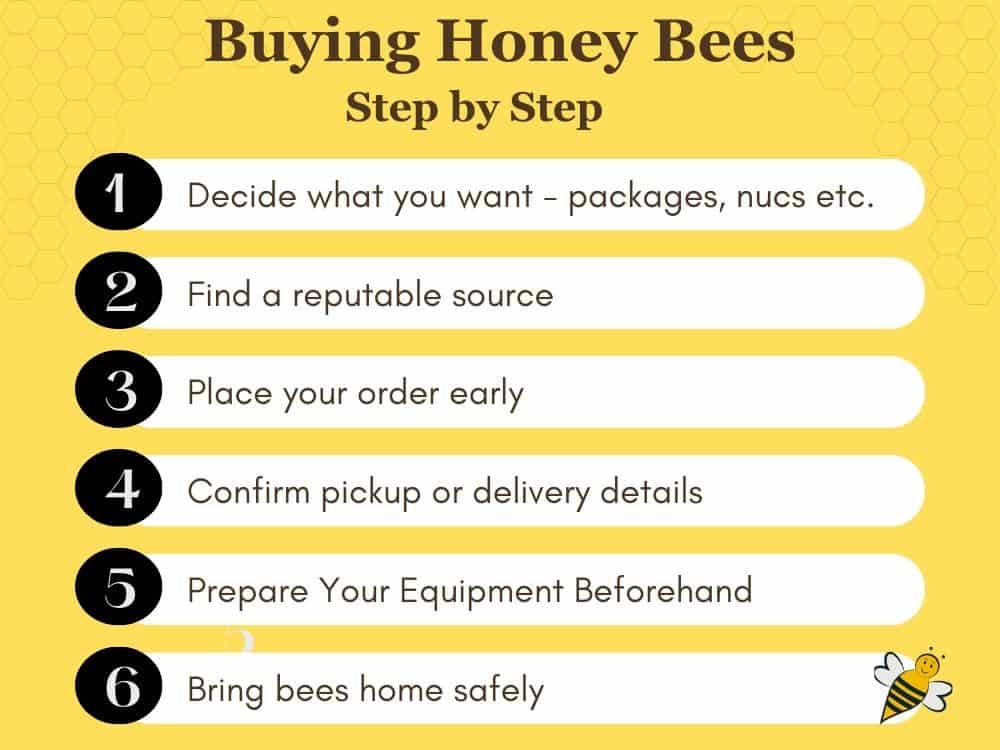
Once you decide what type of bees you want and find a reliable supplier, it is time to place your order. The process is usually pretty simple, but there are a few important things to keep in mind.
- Choose your bee supplier. Find a reputable supplier with bees available for your area. Ask other beekeepers for recommendations if you are unsure where to start.
- Decide what type of bees to order. Choose between package bees, nuc colonies, or an established hive. Some suppliers also offer different races or types of honey bees.
- Place your order early. Follow the supplier’s instructions for ordering and payment. Be sure you understand the refund or cancellation policy before paying.
- Confirm your delivery or pickup date. Make note of when and where your bees will be available. Spring weather can cause delays, so stay in contact with your supplier.
- Get your equipment ready. Assemble and paint your hive equipment well before the bees arrive. You don’t want to be scrambling to finish your hive while your new bees are waiting.
- Pick up your bees promptly. If you are collecting bees from a supplier or post office, make arrangements to get them as soon as possible. Keep them well ventilated and protected from direct sunlight and excessive heat during transportation.
Getting Ready for Your Bees to Arrive
Once your bees are ordered, you still have a few things to do before their arrival.
Make sure your hive equipment is assembled, painted, and placed in a suitable location. You don’t want to be putting together a beehive while your new bees are waiting to move in!
This is also a good time to learn more about basic honey bee management. Taking a beginner beekeeping class can help you feel more confident about caring for your first colony.
And, of course, you need to know how to get those bees into their new home. The process is different depending on what type of bees you purchased.
Review my guides on [installing package bees] and [installing a nuc colony] before your bees arrive.
A little preparation now can make your first day with bees much less stressful – for both you and the bees.
FAQs
The cost of buying honey bees depends on the type of bees you purchase, your location, and the supplier. Package bees are generally less expensive than nuc colonies. Prices vary from year to year, so check with local suppliers for current pricing before placing an order.
Yes, packages of bees can be shipped in specially designed travel cages containing enough food for the trip.
Not usually. A package of bees arrives in a simple travel cage, while a nuc comes with several frames of bees, brood and good – but both require a full hive setup waiting at home.
Not usually. Package bees arrive in a screened shipping cage without hive equipment. Nuc colonies generally come in a temporary box containing frames of bees, brood, and food stores. If you purchase an established colony, hive equipment may be included in the sale.
Honey bees are most commonly available for purchase in the spring, when new colonies have the best opportunity to become established. Availability depends on your location and climate. Some suppliers may have bees for sale at other times, but your choices are usually more limited.
Final Thoughts
Unless you want to get involved in bee lining and stomp through the forest, you will likely need to order some bees for your new hive. There are several ways to do it, and every beekeeper seems to have a favorite. A common saying is: “If there is one thing beekeepers can agree on – it’s that beekeepers can’t agree on one thing!”
The most important thing is to order early, choose a reputable supplier, and have your equipment ready before the bees arrive. Start with healthy bees, and your backyard will be buzzing in no time.
I have a bee hive and would like to purchase a Queen bee
Sorry, I do not sell bees or equipment. I would check with a local supplier.
Hi Charlotte,
Admittedly, I’m a relatively new beekeeper and have been kinda lucky in that I’ve adopted 5 nucs of bees and unlucky to say lost 4 of them. Most recently, in fact, I just lost my 5th last night. Why? It’s a mystery to me hat I won’t get into details about now, suffice to say I’m frustrated. I’ve watched countless hours of instructional video and feel confident in my abilities but not so much in spotting problems, only the results of them. I’m sticking with it tho and this article has opened some new doors for me and my efforts moving forward.
I’ll bee in touch!
Thanks again,
Gregory
Sorry to hear of your troubles Gregory, beekeeping can be a challenge. Be sure to look into my article on Common Beekeeping Mistakes – we all make them from time to time.
I live in Charlotte, NC and would like to take a bee keeping class. Any help would be great.
Mike
I suggest my online class – it will give you everything you need to know to get started.
https://carolinahoneybees.com/beekeeping-class-combo-deal/
I kept bees for a few years and am very interested in starting again. It’s been about ten years.
How do I get involved in your Facebook group? Also how do I sign up for your newsletter?
Hi David, My Newsletter signup is on the home page – just scroll down until you see the pink box. https://carolinahoneybees.com/
The Facebook group is here – https://www.facebook.com/groups/carolinahoneybees
Hi, can I purchase need, that produce white honey; from you?How much are they? Thank you, terry
I don’t sell bees. However, the honey color is determined by the plant nectar used by the bees to make honey. No bees make a certain color of honey.
I received a bee keeping kit as a gift – I’ve been reading and studying and didn’t realize I had to order bees so early ! Can I still order at this late time ?
Possibly, check online and maybe with your local beekeepers association.
My Daughter bought me a bee hive for Christmas as i buy a lot of honey so i need to put it together and get started any help would be much appreciated,
i have no idea as what to do and where to buy my bees and i know time is not on my side,
i live in southern Maine and looking forward to a good start,Thank you in advance
I have at least 1 person in my Facebook group who is located in Maine. If you do not have a local beekeepers association, you still have time to order bees online. Don’t rush though. You have to prepare yourself as well. My online beginners class would be of great help and you may find a local class also.
I was wondering if you sold packages of bees in winter (January or February) if picked up. I live in CT and I practice apitherapy. I lost 2 hives yesterday in the storm we just had and I’m trying to make sure I have enough bees to treat my clients with Lymes disease and cancer. I have indoor hives that they would be going into.
Thanks,
Beth
Sorry Beth, I don’t sell bees at all. I’m a beekeeper but I don’t have a physical store. Best of luck to you.
Great article, so informative Charlotte. I was wondering when I should order bees as I live in Upstate New York, so it is still very cold in January. Is that too soon to order for northern climates? Thanks
Absolutely, go ahead and order. There are a limited number of package bees produced each year. When I order bees, they dont come until April but I order in December! Good luck to you. Would love to have you on my newsletter list.
I’m Cris, I live in Lexington NC. I’ve been interested in bees for several years. I’ve been reading up on how to get started. I’d like to order bees so I can start this Spring. Thanks!! Cris.
Thank you and best of luck. Feel free to join my group on Facebook. Carolina Honeybees Help For Beginner Beekeepers
I live in Ga and want to buy honeybees for spring. Where and when do I order.
That’s great. The when to order is late winter (Dec-Jan). Where to order depends on your location. You can have them shipped of course and I would probably go for one of the big beekeeper suppliers. (Brushy Mountain or Kelly Bees) However, if you can find a local bee supplier within driving distance that is a better choice.
Wow…so much to know. I may do this in the future, but in the mean time, I’m reading everything I can. Great post. Thanks for taking the time to educate us newbies!!
Thank you Wanda. It is a process and you cant learn everything at one time. Continue to do your research and you will be way ahead of the learning curve when your bees arrive. !