
Where to put a Beehive

Choosing a great beehive location can be quite a daunting task. Yet, it is one of the most important things a new beekeeper needs to decide. Beehive placement affects many aspects of the colony’s future success. The optimal place for the beehive location meets the needs of the bees and the beekeeper. Here, I will share some of the most important criteria you should consider when setting up your hives.

It comes as a surprise to many beginning beekeepers to learn the importance of hive placement. You only need a little space to set one down – how can it be a big deal? Yet, it is.
How to Choose a Good Beehive Location
Unfortunately, it is a common beekeeping mistake to fail to give beehive location enough thought. Sometimes, beekeepers set up their hive only to realize later that its in bad spot.
Of course, moving a beehive is possible and beekeepers need to do this on occasion. However, it is much better to avoid this extra task.
Important Factors for Hive Placement
Few people have a perfect location for bees but this does not mean you are at a dead end. Try to meet as many requirements as you can in the space you have available.
- check local beekeeping regulations
- easy access for beekeeper
- avoid damp areas
- protect from high winds
- food and water resources
- protect from predators (and theft)
- public safety
Local Beekeeping Regulations
The best location for a beehive is the one that you have. That may sound confusing but it’s my way of saying that bees can be kept in many locations.
However – in some areas, there are legal limits to how many hives you can have on a small lot. Research local laws and regulations before investing hundreds of dollars in bees and beekeeping equipment and supplies.
Easy Access
Place your beehive in a location that is easy to get to in all seasons. As you perform maintenance or checks throughout the year, will there be mud, snow etc? There are some beekeeping Winter tasks you may need to do.
If you need to make several gallons of sugar water for bees, can you use a vehicle or cart to move food and equipment.
What if you need to move a colony due to falling trees or other reasons. If you have to move a bee colony weighing several hundred pounds you need to be able to get there – even in muddy or snowy weather.
Avoid Low-Lying Areas with Excess Moisture
Hives in moist low lying areas with high humidity may experience an increase in certain honey bee diseases.
If your region tends to be humid overall, proper hive ventilation is your best friend. Ensure plenty of ventilation for the hive. Use screened bottom boards and extra ventilation holes in the bee boxes if needed.
Shelter from High Winds
Protect your honey bee colonies from high winds. Beehives can be top-heavy and they will blow over. Also, strong winds during cold weather make it harder for the bees to sustain a comfortable temperature inside the hive.
If your region experiences a lot of this type of weather – consider creating seasonal wind breaks to aid your bees.
Foraging Resources (Food & Water)
New beekeepers often worry unnecessarily about having food close by for their hives. Of course, having nectar and pollen rich food sources close is great.
But, bees can travel long distances from their hives to collect food they need – in most locations it is not a problem.
However, every beekeeper should think about a water source for their bees. If a natural source is not nearby, it is time to create one. This will also help keep bees out of swimming pools in your neighborhood.
Predator & Theft Protection
Do you have natural predators in your area? If you live in a region with a population of bears, you must have an electric bear fence. Looking for sweet honey and protein rich bee brood – a bear will destroy a whole apiary.
If keeping beehives in a pasture with livestock such as goats or cows, a small fence around the hives is not a bad idea. Cows often turn hives over trying to scratch on them.
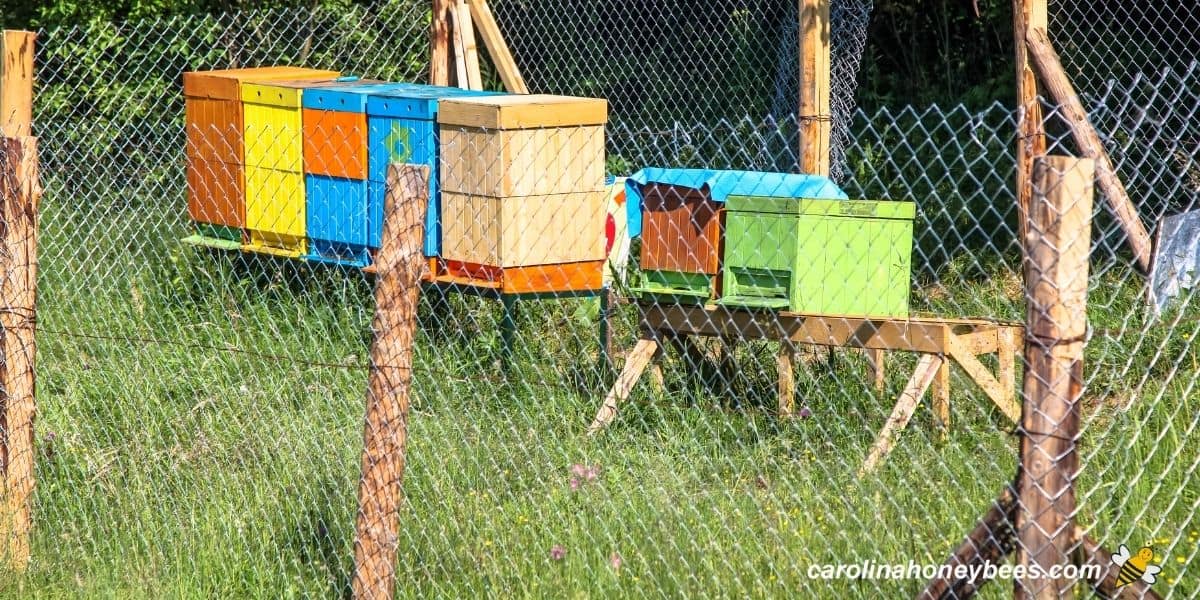
What about human predators? Honey bee colonies are worth a bit of money and many are stolen each year. To combat theft you have a few options.
Try to camouflage the location so well that no one knows where your apiary of bee yard is set up. Or, locate hives within site of neighbors who will help you watch them. Game cameras or electric fences and gates are used by some beekeepers.
Public Safety
No matter how much we appreciate our bees, not every location is suitable for a box filled with stinging insects. Your hives should be located in a spot away from everyday human activity.
Bees need space beyond the physical requirements of the box. They need a clear flight path so they can come and go without hindrance from humans.
Even honey bees will sting to defend their home. Avoid placing hives near children’s play areas or busy walkways. Do you have a section of the yard that is not used very often?
You may need to do some creative thinking. But, most homeowners can provide good placement for beehives – at least a couple.

Get the Buzz on Beekeeping & Life with Bees..
Subscribe to my weekly newsletter. Practical beekeeping guidance, along with honey uses, beeswax projects, and bee-friendly gardening ideas.
More Tips to Finding the Best Place for Your Beehive
The above factors are the most critical in choosing the best place to put beehives. But, here are some more important tips that can make a beekeeper’s life easier and benefit your colonies.
- avoid overstocking
- use hive stands
- place hives away from house
- be aware of local spraying
Don’t Overstock Your Beeyard
The number of beehives you can have in one spot involves factors other than just the safety of yourself or your neighbors.
Any area with managed hives increases the likely hood that your neighbors may come into contact with a honey bee swarm. A frightening experience to those unfamiliar with bees.
You may also find yourself having to feed your colonies more often in times when nectar is in short supply.
Raise Hives Up Off the Ground
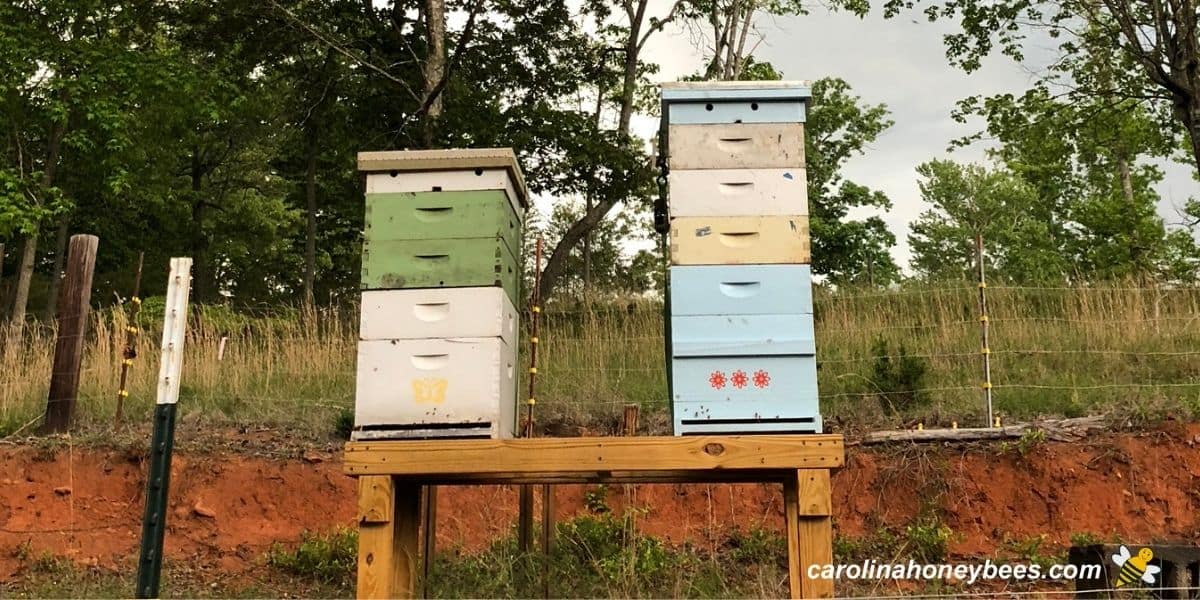
Be sure to put your beehives on some type of stand. Stacked cement blocks (cinder blocks), sturdy stands built of wood or other materials will work.
You can also purchase commercial hive stands that are designed to hold the heavy weight of a production hive.
In addition to being sturdy, don’t make your stand too high up, you need to be able to lift added honey supers off later.
If your hive stand has legs, you could add some type of barrier to help keep ants out of the beehive. You can also check out the options for types of material to put under your beehives to help with pests.
Raising it off the ground also protects your bees from skunks, racoons and other honey bee predators.
Avoid Placing Hives too Near Your House
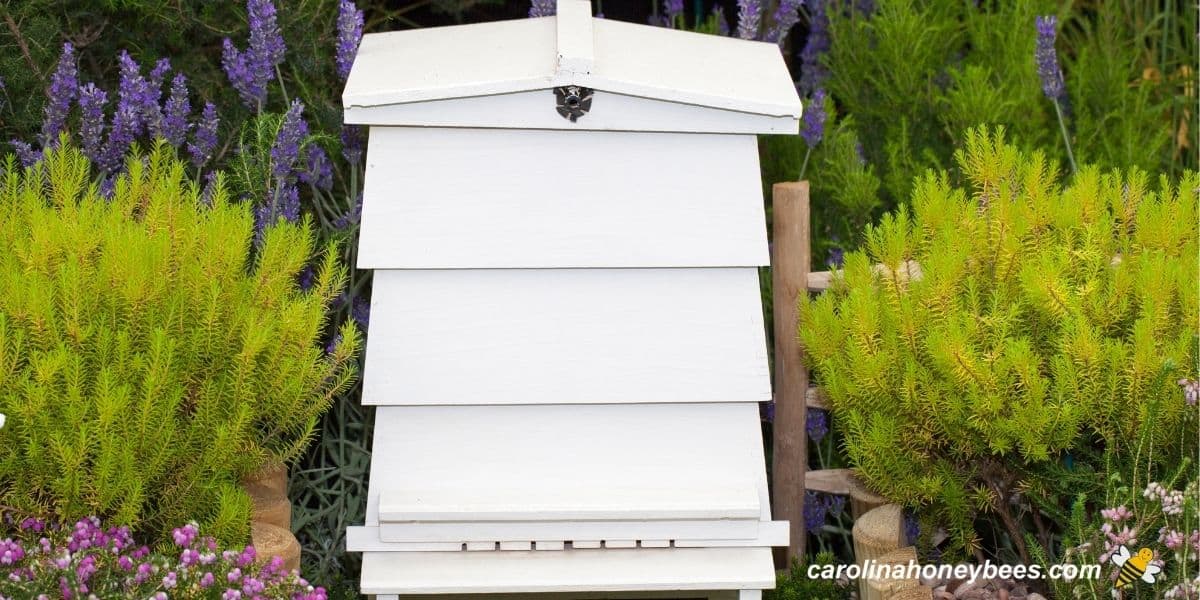
Even gentle easy to manage honey bees can become testy and defensive at times. Inside a beehive are up to 60,000 bees (that can sting). It is not a good item to have sitting right outside your back door.
Honey bee colony temperament changes over the season. Being bother by pest or predators, experiencing a nectar dearth, or queen problems-all can turn your sweet easy going bees into a defensive nightmare. More aggressive honey bees are common in late Summer.
Your neighbors and family members may not experience the “bee euphoria” that is enveloping you. It is much better to have your beehives a bit farther away from the house, rather than closer.
Also, the more colonies you have in an area, the more bee poop you may notice on cars or even the clothes line! You laugh but those little orange splashes can be a big problem.
Consider Local Conditions and Spraying
Some beekeepers will be affected by pesticide spraying by cities and local governments. If this is common in your area, consider how you will protect your beehives from mosquito spraying.
And, if possible choose a location for your hive that is away from roadways that are routinely sprayed with pesticides and even herbicides.
FAQs
Most beekeeping books will tell you to place your beehive so that the entrance of the hive is facing East or Southeast.
Having the early morning sun shine on the front of the hive, warms the bees earlier in the day. This encourages the bees to begin their day with enthusiasm and start to work.
Those of you who live in windy, cold climates might consider providing some protection for your colonies. A wind barrier can be a structure such as a wall, a living wall of greenery or a stack of straw bales.
Whether to put your beehive in sun or shade does depend a bit on local conditions. In general, dappled sunlight is the ideal hive location.
However, beekeepers living in areas with Small Hive Beetle infestations have found that full sun is better to deter beetle reproduction.
You do not have to put your beehive near a field of wildflowers. Though your bees would love it and I am a big supporter of planting for bees.
What will the honey bees eat? Your bees can easily fly up to a mile ( and more) to forage for water, pollen or nectar.
The best distance from a house for the ideal beehive location is difficult to say. Colony temperaments vary so much. Ideally, I would want my colonies to be at least 50 feet from the house or human activity.
Finally
Take all of these guidelines into consideration and choose the best spot that you have! Don’t get too hung up every suggestion if it doesn’t fit your location. Bees thrive in many settings.
As long as you take the needs of the bees into consideration, as well as, human safety – you should be able to find a great place to put your beehive. In my Online Beekeeping Class, I tell students it does not have to be perfect but strive to hit all the positive factors that you can.
Can I split a hive and put new hive beside the original hive
Its not the best option as many of the workers will go back to the mother hive. However, I have done this once the weather is warm. You just have to monitor and population and possibly reverse their spots in a few days.
I am a beekeeper since 1970.Your articles are very interesting and refreshes my mind.Thank you.
Thank you – there are many ways to be successful – I share what works for me.
Hi. I’m David. I’ve started a Bee Hive in the late autumn this year. I’ve just added the second stage to the Hive just after the start of spring. Since I’m on the Sunshine Coast of Queensland Australia I slowly move the Hive to a more shady part of the back of our block. Under the edge of a large ficus tree & Guava tree. The point I want to raise is that we are in the Southern Hemisphere so everything is around the other way with seasons & times to do thing. So it get a bit confusing on when to do different tasks.
Yes, your seasons are opposite ours in the US. It can be confusing.
Thank you for all the well presented info! I’m new to this world of bees and trying to learn all I can. I joined a beekeeper association and will be taking classes next month. What reading material do you recommend for us newbies? Would love to have anything you’ve published!
I do have a book and a journal Jeannie. https://carolinahoneybees.com/buzz-into-beekeeping/
Thank you so much for your great information! It is appreciated! Being a 2nd year Beek, I have lots to learn! Again, thank you!
Best of luck to you Derek. Learn all you can before the bees arrive and this will be a big help.
Going to start this coming spring Thankyou i learned a lot from reading this ..as i know little on bee keeping
First off LOVE your site! I live in the north ,what’s the best time of day work with bees?
Thank you, when possible morning inspections or at least before 2 PM are best – most of the older field bees are out working.
I love these tips—thank you!
An additional question—if I plan on raising chickens, how far away should I keep their coop from hives?
Thank J.R. I know some folks who keep hives in the chicken pens but I would not. As long as the hives are 20 ft from the chickens – or there is a wall between the hives and chickens – I think you would be okay.
Hi, my neighbor is placing 2 beehives within 2 feet of our 6 ft fence, 8 feet from our back patio, and12 feet from our house (and 100 ft from his house). My wife and I were not consulted about this. We own a dog who had a bad reaction to a bee sting a while back. While we’ve read that a fence in close proximity to a hive can redirect bees’ flight paths safely above people’s head, we’re still concerned about the potential for swarms and an elevated presence of bees in our backyard. Are our concerns legitimate or unfounded?
Assuming this is a solid fence, I would not be overly concerned about flight paths. You may have more bees in your yard but that depends on how many were there already. Anytime beehives are kept in neighborhoods, extra caution is necessary on the part of the beekeeper. If you have a good relationship with your neighbor, perhaps you could express enthusiasm for his effort to help bees – while expressing your concerns too.
My husband “gifted” me 3 hives ( with bees ) last week. I left my career city job and run a tropical hilltop homestead alone. I have all the resources and assistance I may need – Beekeeper’s Bible and Beekeeping for Dummies to boot.😊 And away we goooo!!
Thats awesome! Best of luck to you!
Question, how do I mow around my hives? Will that disturb them to much?
Yes, it may. Most of us create an area around the hives – especially in front of them that is grass free. Also, using a battery powered string trimmer (while wearing a bee suit) is effects. It is the space in front that is the biggest issue.
Interesting information! I just bought two bee hives from London Drugs, (no bees yet), and have gone from knowing nothing, (I just thought you got a bee hive, some bees, then let them do their thing), to now studying and talking to bee people about bees. I realize there is a whole lot to know about bee keeping and will not be getting the bees themselves until I get more educated about them!
My next door neighbors got five huge bee hives two years ago, and a bear destroyed two of them, and with the last three hive, the bees all died over winter. We had a pretty brutal winter and with the strong winds we get up here, the temperature gets to be really cold out.
I see deciding where to put them and including shelter from the wind is going to take some thinking.
You are very wise to take the time to really understand what is involved in beekeeping. It is a wonderful hobby.
Thank you for the great advice Miss Charlotte. I have wavered about whether to place my bee hives in the sun or shade. We get very hot/humid weather but the sun is so intense that my bees tend to beard if I put them in full sun. They are currently located under a large crepe mertle tree in the back corner of our fenced yard. However, hive beetles are present. I’m using beetle traps and am going to start putting in swiffer pads as well this inspection. I also am planning to build them a concrete patio to go under the hive to reduce beetle hatching. Thinking about placing it more in the sun/out from the tree shade. Thoughts?
Perhaps a happy spot in the middle. A bit more sun without being directly in the hot sun all afternoon.
This is my third year lots to learn
I have been doing bees for a long time but I still have a lot to learn too. Don’t forget to have fun.
Thank you very much
I have kept bees for 40 plus years
I learn all the time
Jeremy
All wise beekeepers continue to learn.