
Essential Oils for Honey Bees

In the quest for healthier colonies, the use of essential oils for bees has become a popular practice. These natural oils derived from plants are an important tool in many beekeeping circles. While not a cure for every problem facing our honey bees, the oils are believed to be a positive influence on colony health. Let’s look deeper and consider what some of the most commonly used essential oils in beekeeping can do for your hives.

Of course, bee health is at the forefront of any hive management technique. Always consider the safety of the bees and yourself when using these powerful substances.
Benefits of Using Essential Oils in Beekeeping
Many studies have suggested that small quantities of essential oils used in bee food or other applications have positive effects on bees. These include:
- better overall colony health – help prevent honey bee nosema (an intestinal disease)
- possible mite control (tracheal and varroa)
- aid in new queen introduction
- use as a swarm lure
- keep syrup from becoming moldy.
Improve Honey Bee Health
Our bees live in the natural world-where they are exposed to numerous pests, pesticides and harmful environmental factors.
These stresses affect the ability of bees to take care of themselves. They are more likely to succumb to new honey bee pests.
As bee health declines, we see a desire for more natural methods (instead of synthetic chemicals) for use in our beehives.
Mite Control
Essential oils have been used in the control of tracheal mites and varroa mites. Some research shows positive results.
Is using essential oils for mite control a sound- more natural option to hard chemicals? Maybe. But this is only true if the treatment has a good efficacy (meaning it works) and does no other harm to the colony.
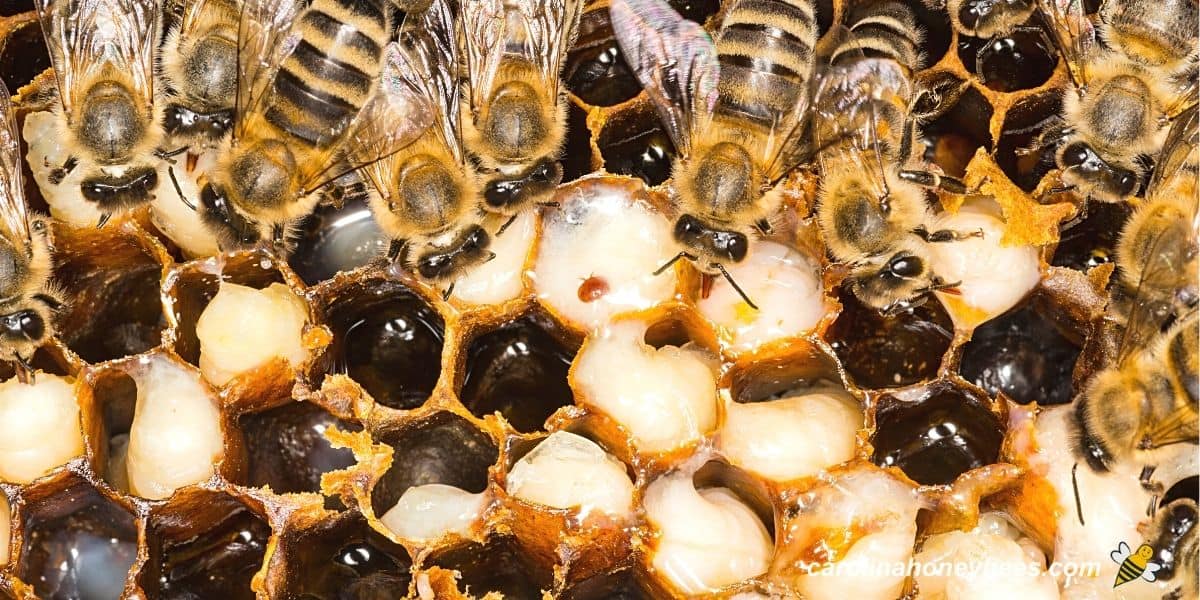
Queen Introduction
Requeening a hive can be a nervous time. Will the new colony accept her? Or will the $40 you just spent be wasted and a young life cut short?
Some beekeepers use a mild essential oil compound when introducing a new queen into the hive. Hopefully, this helps ease the transition for our winged friends.
Swarm Lure
Honey bees are very “scent” driven. Their ability to find and recognize scents are far superior to our noses. Using essential oils as a bee swarm lure is a very common practice. Lemongrass Oil is the most popular choice.
Keeping Bee Syrup Mold Free
If you understand the importance of feeding bees – when they need it, you have spent some time preparing syrup.
Feeding bees sugar water is not an inexpensive endeavor – you don’t want to waste any. A small amount of essential oils are often added to sugar water to keep it fresh longer.
Most Common
The most popular essential oils used by beekeepers are:
Thyme & Spearmint
Some of these possibly assist in mite control by confusing the mites or blocking their breathing pores. Both thyme and spearmint have been used in this capacity. Thymol is also active against fungus and somewhat effective in control of tracheal mites.
Lemongrass Essential Oil
The most popular oil used for honey bees is Lemongrass. It is used as a treatment for pests, a supplement for health boost or as a bait to lure to attract bees to swarm traps.
Lemongrass is anti-fungal, anti-viral and antibacterial. It does mimic some common honey bee pheromones. Be careful when using any lemongrass product with weak hives.
The scent may attract robber bees from stronger hives. The weaker colony may not have enough bees to protect themselves resulting in loss of the hive.
Tea Tree Essential Oil
Tea tree oil can actually be used to keep bees away. However, it is used in some beekeeping essential oils as an additive to sugar water. You will find it in some commercially available supplements.
Wintergreen Oil
Wintergreen essential oil was one of the first oils used to try to curb that advance of varroa mite infestations in beehives. Today, it is not used as much and it is a powerful oil so if you choose to include it in your program – be careful.
Popular Beekeeping Essential Oil Recipes
Here is a collection of some of the most popular essential oil recipes used by beekeepers. However, some of the methods of application and many of the oils are not legally approved for use in beehives. Do your research and make your own mixes at your own risk.
Recipe #1 Bee Health Boost
- 2 ½ cups water
- 2 ½ cups sugar (pure cane)
- 1/16 teaspoon of lecithin
- 8 drops of Spearmint Oil
- 8 drops of Lemongrass Oil
** Blend well – always shake before use – Use 2 tsp of this concentrate to a quart of sugar water feed
Recipe # 2 Health Boost
- water – 1 Cup
- 1 tsp tea tree oil
- Use 1 tsp lemongrass oil
- 1 tsp spearmint oil (or wintergreen)
Blend thoroughly in a blender (5 min). Pour into ½ gallon jug and add enough water to make 2 quarts.
Do NOT heat the essential oils. This will make a concentrate. Use 1 cup of concentrate to 1 gallon of cool sugar water syrup.
Grease Patties and Essential Oils
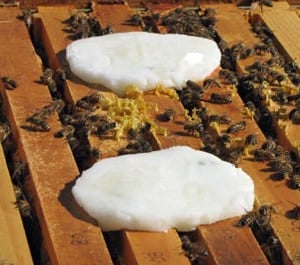
Grease patties are not as popular as they once were but some beekeepers still use them. A mix of Crisco shortening and sugar -they were originally used to combat tracheal mites.
The addition of essential oils “may” provide some varroa control. Grease patties can be used on hives most of the year.
But, they sure are a mess in hot weather! Therefore, the beekeepers who still use them do so mostly in the Winter. They should not be used when collecting honey for human consumption.
Other Bee Feeding Supplements
If you don’t have the time to make your own essential oil recipes for your bees, you do have a few options that are ready to use.
“Honey B Healthy” (HBH) is a popular supplement for improving honey bee colony health. It is a proprietary blend containing essential oils and other ingredients. A small amount of HBH added to sugar water serves as a nutritional boost.
Many beekeepers use a 1:1 sugar water mixture to stimulate brood rearing. This supplement helps keep the syrup fresh.
I have used it for years and cannot say enough good things about the product. You will always find a bottle of Honey B Healthy in my equipment shed.
These products are often added to sugar water, mixed into pollen patties or added to sugar water for spraying directly on the bees.
Other choices include:

How to Use Essential Oils in the Beehive
The most common method of application is adding the oils to the mix when you are making sugar water to feed bees.
Many beekeepers spray some of the recipes (mixed with sugar water) directly on the honey bees. Do this with caution! -don’t chill the bees or spray directly into the cells. I would encourage beginner beekeepers to feed instead.
Pollen Patties With Essential Oils
When used properly, pollen patties that already contain essential oils can be a good choice for the beekeeper.
It is important to keep in mind that pollen patties must be used with EXTREME care in regions that have Small Hive Beetles.
Beetles love pollen patties and can destroy a colony in a short time. Most beekeepers that suffer from beetle problems keep Small Hive Beetle traps in the hive.
You can make your own protein pollen patties. They can be frozen and used as needed. When to use them and how much to use will depend on your location.
Expert Tips
- Be careful – follow recipes, measure carefully. Essential oils are powerful stuff!
- It is a well known fact that water and oil doesn’t mix easily. Getting your oils to disperse well in sugar water is made easier by the use of Lecithin Powder (lecithin granules).
- VERY small amounts – most folks add too much product. Proceed with caution.
- If you decide to try using essential oils in your beehives, do your research first and don’t trust the opinion of only one source. (Not even if it is me.. LOL)
I always tell the students in my online beekeeping class that controlling mites is one of the most important keys to beekeeping success. And that involves testing for varroa mites so you know what you are dealing with.
Are Essential Oils Safe for Hive Use?
In the struggle to keep hive healthy, the idea of using natural oils in your beekeeping program is appealing. They are natural products so we should have few worries, right?
Not exactly. Even though these oils are natural products-that does not mean they should be used “willy nilly”. They are powerful compounds and can do great harm when used in the wrong way.
We do not have solid evidence that the use of essential oils will handle varroa mite issues. But, they may aid bee health in other ways that helps promote productive hives.
Monitor your hives and if necessary consider some of the other softer varroa mite treatments such as oxalic acid to kill mites on the bees or perhaps a formic acid procedure.
FAQs
The most common method of using essential oils in beekeeping is to add them to food. Sugar water formulas and pollen patties are good examples.
When used in the proper strength and application many oils promote good bee health. But, even natural essential oils can be toxic to bees and other insects. Use with care and follow recipes from reputable beekeepers with experience.
Peppermint oil has a scent that bees do not prefer. It is sometimes used to discourage bees from an area. It should not harm bees as long as it is used in a diluted form.
Final Thoughts
Many beekeepers are devastated emotionally and financially as they watch colony after colony perish from mites and related health issues. In desperation, some try non-approved methods. Some of these are great ideas that are ahead of their time and some can end in disaster. How should you use essential oils for bees? Very carefully.
I grow a lot of thyme. What are your thoughts of cutting handfuls of thyme and laying them across the frames for the winter?
I’m not sure Tammy. It might cause more harm than good. I would be hesitate to do it unless some reputable beekeepers can explain more.
Why not use hops essential oil as a treatment for mites on honey bees sense hopsguard is being used as an effective treatment?
Essential oils are natural but concentrated and powerful. I would not advise hops at this time because I have not read of anyone using them. I am always concerned about safety. And any EO is not a silver bullet for mites – my hope is that they promote good health and this is good for the colony over all.
Can I rub some essential oil (menthol, eucaluptus or thyme on the front entrance of my hive to discourage mites?
I dont think it would work. When essentials give some benefit in the hive, I have found that it is either through direct contact with the mites and/or just promoting overall better health in the bees. Keep in mind that undiluted oils are very powerful, it might cause a bigger problem.
What is the grease patty recipe?
Embarrassed to admit that I dont really use a recipe most times. I measure out how much dry sugar I think I will need to make the patties and then add enough crisco to make it stick together. If you are adding Wintergreen Essential Oil to the mix – you must wear gloves as it can absorb through the skin and become a danger to you!.
how many lemongrass oil needed for swarm box? New to bee keeping Nova Scotia Canada
I would apply 3 – 4 drops and repeat every week or two. Bees have a keen sense of smell . We dont want to overwhelm them.
At a recent bee conference, a speaker suggested adding a scent to a water dish near the beehive. This will teach the bees what good water is supposed to smell like and, hopefully, discourage them from visiting the neighbor’s dog’s water bowl. What oils would you recommend and what ratio of water to oil? (I don’t want to make it too strong.)
I think you might try lemon grass oil but it would only be a drop or so. Bees are very sensitive to scent.
In your two Bee Health Boost recipes, there is no thyme oil. Why? What’s the difference between Honey B Healthy and Bee Health Boost? Would you alternate Honey B Healthy and Bee Health Boost?
There are many different recipes in use by beekeepers. I would use either Honey B Healthy or Bee Health Boost. Either should work as well.
I’ve done lots of research to understand the different varroa mite treatments. At this time I’m looking at vaporizing OA as my primary method but I like the idea of using essential oils. Have you investigated using FGMO and essential oils in a fogger like a Burgess mdown?
Most of the beekeepers that I know who used fogging (FGMO) did not have good results. It was found to be no more effective or even less than other methods. It is not approved and no reliable studies have been done to show effectiveness. So, I have never used FGMO. I would not recommend using essential oils in that method either. We have to remember that even though they may be natural – they are still very potent. You risk doing harm to the bees and/or yourself.
recently I have been working with a hive that is very weak after coming out of winter. they had plenty of honey,,but a lot of the bees died. I have tried putting in a couple of frames of brood. I cannot see any eggs. don’t know if my queen is laying.
Adding brood is good. If you add a frame of brood with fresh eggs, the bees will begin to build queen cells in 3 or 4 days.
Love your blog! Question re: #2 herbal health boost with tea tree, lemongrass, speaking oils: is this a sugar water spray like recipe #1? I’m a new-bee, so my apologies if this is a silly question.
Thank you Barbara. No serious questions is silly. You sure could spray a lite mist of this recipe on the bees during inspection. However, in general I think it best to feed it to them.
Charlotte,
thanks for the info,
need help to keep hives alive.!!!/
this late winter 2018 March,
4 of 5 are dead sense last summer.?
I have gotten bee nukes
from Brushy Mountain Bee Farm
each May,
they often sworm 1 or more times before summer,
even through there may be 3 honey suppers above 2 deep brood boxes.?
I need help keeping Bee hives alive !
now , retired,
as
Dan the Honey Man
Keeping bees alive is certainly not as easy as it once was. Bees do swarm. It is natural even though is it not always best for beekeepers. Finding a way to control varroa that works and keeping good queens in you hives is a must.
How often should I refresh the lemon grass oil in a swarm trap? I plan to put a few drops on a wick in a partially open zip lock bag.
I think it would depend somewhat on the weather and temperature. Weekly perhaps.
Thanks learnt a lot.
Any advise on how to use essential oils to keep a small new colony from absconding?
Btw:
“These important pheromones control activates inside the hive.” Do you mean”activities”?
I’m not sure any essential oil would encourage bees to not leave a hive. Even though using too much of some mite make them leave! LOL Yes thanks.
Do u ever use Pro Health in your sugar cakes?
I have not Rick but just because I’ve always had access to Honey B Healthy. Pro Health seems to be a similar product and I would expect it to work about the same.
When you use oxalis acid do you close the hive up completely.
I do for just a few minutes.
I put lemongrass oil in one of my bee waterers. The bees stopped using it. Did I do something wrong?
Perhaps you put too much Claire, bees have very sensitive noses. ( Hmm .. maybe I should say they have great olfactory senses).