
Why Honey Bees Get Aggressive?
New beekeepers are often amazed to find that their beehives are suddenly aggressive? Those sweet Spring colonies have grown into large beasts – especially during the late Summer. There are several situations than can affect the defensiveness of your beehives. Let’s investigate some of the circumstances that can change the mood of your honey bee colony.

Being stung is one of the less attractive parts of beekeeping. Why do bees sting? In general, stinging occurs when the bees feel provoked. Sometimes it seems to take little to provoke them. But, bees do everything for a reason. As you gain experience, you can learn how to gauge the mood of the hive.
Common Reasons for Aggressive Bees
Honey bees are generally not aggressive-they are defensive. This characteristic of honey bees is one reason we are able to work with them with a minimum of fuss.
Most of the time, they will not attack unless they feel threatened. This is defense not offense.
However, terminology aside, there’s no need to “split hairs”. Angry (or defensive) bees are no fun – no matter what you want to call them.
Hive inspections are more difficult with 50 angry bees bounding off the front of your veil. And, you do not want to get chased away every time you are within 50 feet of a hive.

Top Reasons for Very Defensive Bees
There are many factors that affect the level of aggression in your bee colonies. Some are environmental, some and internal – some you can control, while others you simply can’t.
Environmental Triggers That Make Bees Defensive
Weather has a major affect on the mood and activites of a honey bee colony. Poor weather conditions may keep more of the older defender bees at home – or just make the hive cranky in general.
Hot, Humid Weather
Many beekeeper’s notice a mood swing in their colonies for the first time during late Summer. The sultry, high humidity temperatures don’t improve anyone’s mood – including your bees.
As temperatures soar, worker bees are very busy:
- ripening honey
- collecting water
- ventilating the beehive
Large colonies working in extreme heat are stressed and cranky. In some regions, beekeepers can try to keep their hives cooler in hot weather – but this only works to a degree (no pun intended).
You should also protect yourself. Most of us choose to wear a bee suit or jacket – beekeeping in the Summer can be dangerous.
Nectar Dearth (Lack of Food)
Most regions will experience a nectar dearth at some time during the warm months. A dearth (lack of abundant nectar/pollen) may last for a few days or several weeks. It hits my area in mid-late Summer.
This lack of incoming food creates stress in the colony. Less food = more defensiveness. The queen bee may stop laying eggs and if the food shortage continues – drone bees may be evicted to save on resources.
Late Season Bees Behavior
Late Summer to early Fall, is the most common period for our bees to “get an attitude”. The bee colony senses the end of the foraging season is approaching.
This can be especially frustrating to the beekeeper trying to do some Fall feeding of bee colonies. The bees don’t know you are trying to help – they are much less tolerant of disturbances.
Winter survival of the colony depends on sufficient food stores.
Hive Conditions That Increase Aggression
Of course, it is not just external factors that affect the temperment of honey bee colonies. Hive conditions play a major role in your bees’ outlook on life.
Queenless Hives are Known to Be Cranky
The role of the queen bee is vital to colony continuation. She is the only layer of fertilized honey bee eggs that develop into worker bees.
But, she serves another important function. The queen emits special honey bee pheromones (chemical messengers) that hold the colony together as a family and helps regulate hive functions.
In a queenless beehive, those pheromones are missing, nervous, aggressive bees may be the result. The colony is in a frantic struggle as they know something is wrong.
Large Colony Populations
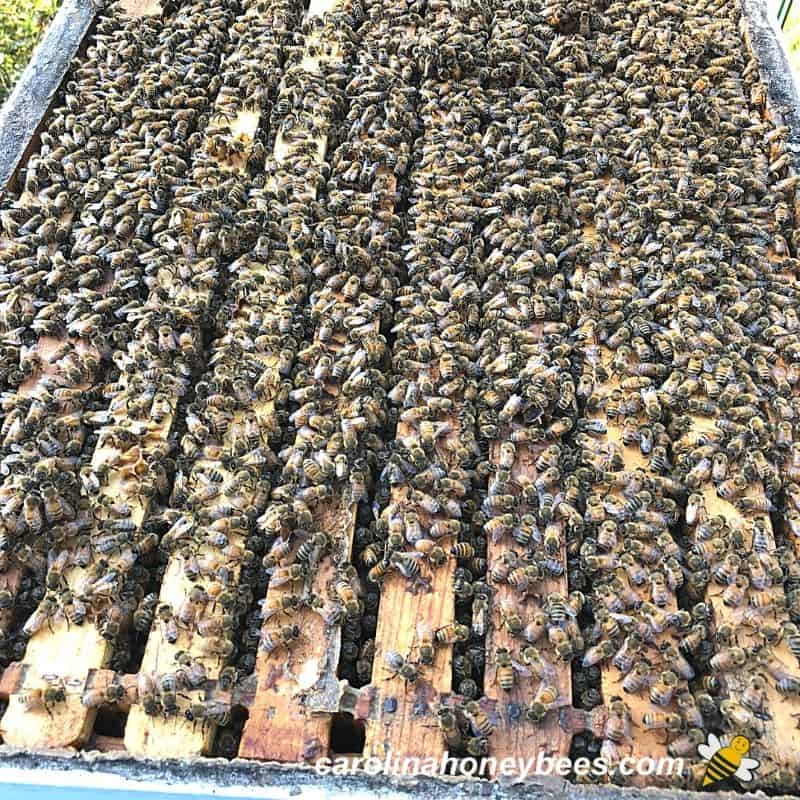
That sweet little starter set of package bees you bought in Spring is now 40-60,000 strong. Large colonies of older bees are very protective and they have enough members to offer a strong response.
More bees means:
- more guard bees
- stronger defensive response
High Varroa Mite Levels
Any unhealthy hive is prone to be cranky. Heavy varroa mite loads stress the colony and weaken overall health. You may notice a stronger defensive response in hives with high mite infestations.
External Threats That Put Bees on High Alert
Actions that take please outside the hive also affect the defensiveness of your honey bees. Rather than aggression, honey bees generally are programed to defend the hive – bees, brood and food stores.
Robbing Behavior
Worker bees will fight, often to the death to keep out or evict intruders. When robbing bees (fighting) begins at the entrance, alarm pheromones are released.
This alarm notifies the rest of the workers of a threat and is a call to action. All stingers on deck.
You may not be a robber bee but any hive that is being bothered by potential robbers gets rather testy at any disturbance.
Predators (Bears, Skunks, Hornets, etc.)
If you live in an area with a hefty bear population – plan to install an electric bear fence before trouble arrives. A bear can destroy your apiary and get every hive in a defensive mood.
But smaller animals can cause bees to have a testy attitude too. For hives that are set low on the ground, skunks can be a problem.
Each night the skunk stands in front of the hive and scratches. When the guard bees come out to investigate, the skunk eats them.
Prevent this problems by using hive stands to keep colony entrances out of reach.
Yellow Jackets prey on honey bees, large hornets and other insect pests can be a problem during the late season.
This activity can put your hive on constant alert. Using yellow jacket traps earlier in the season may help – but it wont get rid of all of them.
Beekeeper-Related Causes of Aggressive Bees
Can it be that we beekeepers sometimes cause increased aggressive behavior in our honey bees? Yes, it can be!
Here are some ideas to consider and avoid when you are planning a visit to inspect your beehives!

Improper Use of a Bee Smoker
The use of a bee smoker can be a blessing to your time inside the hives. But used improperly it can make matters worse.
Cool, white smoke does not harm your bees. It distracts them from your inspection and helps mask alarm pheromones.
However, hot, black smoke should be avoided as this can cause your bees to react negatively.
Rough Treatment During Hive Inspections
Staying calm while performing hive inspections can be difficult-especially for new beekeepers. However, it is important to avoid quick movements and banging hive components together.
Honey bees react to:
- sudden motion
- vibrations
- alarm pheromones from injured bees
Fast hand movements and vibrations can cause the honey bee colony to become defensive and go into attack mode. Be gentle – move slowly.
Dirty Bee Suit or Gear
Okay, do you stink? Well, I mean does your beekeeping suit stink? If your suit or beekeeping gloves have alarm pheromones or venom from previous stings this may trigger an aggressive response.
Bees are very sensitive to odors. Sweat or other strong smells can have a negative effect on the attitude of your hive.
Wash your bee suit occasionally. And, as I always tell the students in my online beekeeping class – “don’t go to the bee yard smelling like a bear.”
Genetics and Bee Termperament
It’s all in the genes – or is it? Truth is – genetics does play a role in honey bee behavior.
Natural Genetic Differences
Among the different types of honey bees some genetic lines are more defensive than others. This varies even among the same breed or race.
Genetics come from:
- The queen bee (50%)
- The drones she mates with (50%)
If your colony replaces their queen, the new bees will come from a different gene pool and could be more aggressive (or not).
Africanized Genetics
Africanized bees (Apis mellifera scutellata) are present in many parts of the Southern United States. Colonies with these genetics are much more defensive than the regular European Honey Bees.
The media has labeled them as “killer bees” due to the danger involved when a colony is alarmed.
Confirmation of African genetics requires the use of a lab, you can not identify them with the naked eye. If you live in an area with known African genetics, be vigilant in keeping docile queens in your hives.

Colony Temperament Changes Over Time
It is important to understand that the temperament of a honey bee colony can change at any time. This is why finding the best location for your beehive is so important.
Place hives far enough away from your house to have a buffer zone. The entertaining, docile new hive sitting beside your back door in April, may seem to be a monster in September.
This is a common beekeeping mistake that is easy to prevent.
Dealing with Aggressive Honey Bees
Among the many factors that affect the temperament or aggressiveness of our honey bee colonies, some can be lessened.
- Inspect your colonies when the weather is nice
- Use your smoker with cool white smoke and be gentle
- Make and feed sugar water to your bees if they need it
- Control mite levels in your colonies – learn when to treat hives for mites
- Reduce the size of your hive entrances if you notice any robbing
- Requeen beehives that are constantly overly defensive
FAQs
Honey bees show varying levels of defensive behavior. But, the most common honey bee to show aggressiveness is the Africanized Honey Bee (aka Killer Bees).
Several factors inside and outside the hive contribute to aggression in honey bees. These include, bee genetics, colony size and health, availability of food and hive management.
Numerous workers buzzing loudly and clustering around the beekeepers head area as a sign of aggression. Also, bees that chase humans when they approach the hive from what use to be a safe distance.
Finally
The first bees brought to America (Black Honey Bees) were hearty insects but known to be defensive. Over time, bee breeders selected for more desirable traits.
A little patience may allow the colony to calm down. Or, you should consider giving them a different queen and hope that her genetics will produce a calmer bee.
Good afternoon,
I live in Kenya and deal with African Bees, they are normally bad tempered by nature. I have a number apiaries and have to work on bees at night or early evening. I have tried a number of times doing it during the day but simply chased off and any livestock or people around getting stung. Even when fully suited up still get stung through my suit. As a H&S rule we do not Beekeep during the day and never alone. Honey is Magic 🍯🍯
Lucky to Beekeep with European bees.👍
Thank you for your input. You are correct. Africanized honey bees are a special case. I find them interesting but I am glad that I don’t have to open the hive! Stay safe!
I live in central Mississippi.Is there a best time to harvest honey? Is there a worst time to harvest honey? Is now a good time? Thank you.
The best time is when the honey is ready and your local flows are over. That said, you don’t want to take all their honey and leave nothing in the box for them to use with nothing much expected in the coming weeks. You can’t put a time on it. For instance, I harvest wildflower in late May/early June. Then if I am lucky a little Sourwood in late July. I know that in my area there will not be another major flow during the season – and my bees will need that there is for themselves.